

Mario 101: For Super Players
This is not a Super Mario blog. This is a video game history blog that can and should encompass all games. That said, there are a lot of Super Mario games and I do play most of them, so if I’m writing all this based on my own interests, Mario is going to come up a lot. That’s why Mario seemed like the most logical way to celebrate my 100th post. Instead, that post ended up being about Legend of Zelda, and then I kept writing, so I guess this is celebrating the 137th post on this blog, which is less of a milestone, I admit.
This particular project is about the history of Mario, his games and the various associated spinoffs. You will find some history you know, some history you don’t, and in more than one case, contradicting stories that suggest that there’s more to the story than the popular version that usually gets told. While I do talk about the entire series, I move more or less chronologically, starting with Donkey Kong and only really getting as far as Yoshi’s Island and Donkey Kong Country. So while Super Mario 64, Super Mario Galaxy and Super Mario Odyssey get discussed, they don’t have their own sections. I may get to them in the future.
This project comes in seven parts. You’re on part one now. Part two covers Bowser, Peach and various Super Mario Bros. elements. Part three covers the enemies of Super Mario Bros. Part four mostly focuses on Super Mario Bros. 2. Part five covers Super Mario Bros. 3 and Super Mario World. Part six covers Yoshi’s Island and Donkey Kong (both the arcade original and Donkey Kong Country). And part seven is a round-up of various supporting characters like Wario, Daisy and Rosalina.
EDIT: And now there’s a part eight that’s all the stuff that didn’t make the cut for the first version of this project.

Enjoy. I hope everyone who reads this will learn something weird about a certain plumber and the expanded video game universe he inhabits.

1. Mario may not have been named for Mario Segale.
The general consensus states that Mario was named after Mario Segale, the Seattle-area landowner who leased a warehouse to Nintendo starting in 1981. But the stories vary about exactly how Segale’s name got attached to the character who would become Nintendo’s mascot. Some stories explaining Mario’s name omit Segale altogether.
In his 1993 book Game Over, author David Sheff alleges that Segale was chosen as the namesake after he fortuitously knocked at the door of Nintendo of America’s Tukwila, Washington, warehouse, interrupting a discussion about what to call the playable character in Donkey Kong.
[Minoru] Arakawa answered it. Standing there was the owner of the warehouse. In front of everyone, he blasted Arakawa because the rent was late. Flustered, Arakawa promised that the money was forthcoming, and the man left. The landlord's name was Mario Segali. “Mario,” they decided. “Super Mario!”
Even though this story has been repeated often, including in IGN’s 2015 history of Super Mario Bros., it strikes me as suspicious for a few reasons. For one, real life rarely plays out in such a dramatic fashion, and for another, it’s telling that Sheff misspells Segale’s last name as Segali. Third, Sheff’s book is also the source of the urban legend that Pac-Man was named after a hockey puck, which I do not think is true. Fourth, the character wouldn’t be called Super Mario until 1985, years after this meeting would have taken place.
Fortunately for us, that story is contradicted by Don James, who would become the executive vice president of operations for Nintendo of America but who in 1981 was the manager of the company’s warehouse. In a 2012 episode of Wired’s Game|Life podcast, James gives an alternate and contradictory origin story.
A long time ago, they sent Donkey Kong over to us when we were at a little tiny warehouse down at [the Southcenter mall] in Seattle. We were standing out there, myself and Mr. Minoru Arakawa, who was president [of Nintendo of America] at the time, and the character in Donkey Kong was called Jumpman in Japan, and they said, “What do you want to name it in the USA?” … [The] guy who owned the lease on our facility was named Mario Segale, and so we thought, this guy is a recluse, no one’s ever actually met him, so we thought, “Wouldn’t it be a great joke if we named this character Mario?” And so we said, “That’s great," and we sent a telex to Japan, and that's how Mario got his name.
Obviously, James’ account and Sheff’s version can’t both be true. And while James’ version seems more plausible, the wonderful website The Mushroom Kingdom, which has been a repository of Super Mario information for decades, points toward the accounts delivered directly by Mario’s creator, Shigeru Miyamoto. The earliest version I can find appears in a Reuters story that ran in the August 13, 1986, edition of the Toronto Star, beneath the headline “Japan’s hottest hero a two-inch-tall Italian.” Oddly, this version of events doesn’t mention Mario Segale at all, instead placing the origin of the name before Nintendo ever moved into its west coast digs. In the second-to-last graph, a 33-year-old Miyamoto tells the reporter that the character “was dubbed Mario by colleagues who said the big nose, moustache and overalls resembled the Italian caretaker at the small New York hotel where Nintendo employees stay in the United States.”
This version of events seems to be reinforced by a 2005 MTV.com article in which Miyamoto repeats the same story about the character getting the name before Nintendo ever started paying Mario Segale rent checks. However, in a 2016 video about “Mario myths,” Miyamoto nonetheless seemed to confirm that Segale was, in fact, the origin of Mario’s name.
And then in a 2022 interview with Nintendo Dream magazine, Miyamoto recalls it without tying it to a physical location.
I’m not sure if it was a staff member at [Nintendo of America] or an employee from Japan who went to NOA that was the first to bring it up, but there was someone named Mario in America. We used that person’s name. … I believe the name of the owner of the warehouse we were renting was Mario. So before I had decided, I kept hearing people calling him “Mario” and thought, “That’s fine, isn’t it? Let’s go with that.”
I don’t know how to reconcile all these apparent contradictions, but that will be a theme throughout this project.
EDIT: After this post went live, Chris Kohler responded on Bluesky to point out something that had not occurred to me before. The naming of Mario occurred in the U.S., not Japan, and no version of the story has Miyamoto being present for it. As such, all versions of the story Miyamoto has recalled in interviews have him repeating something he would have heard second-hand. While this does give a possible explanation for how and why the story has changed, I think, it also underscores the problem of Miyamoto being held up as the storehouse for the collective memories of the entire company. He is the go-to figurehead, but he doesn’t and can’t know all.
2. Mario was not named in the original Japanese release of Donkey Kong.
At some point, I got it in my head that Jumpman was the character’s Japanese name, and that Nintendo of America rejected that in favor of Mario for the western release. That’s not true. In the original Japanese flyer, he’s only referred to as “the player” (プレイヤー).
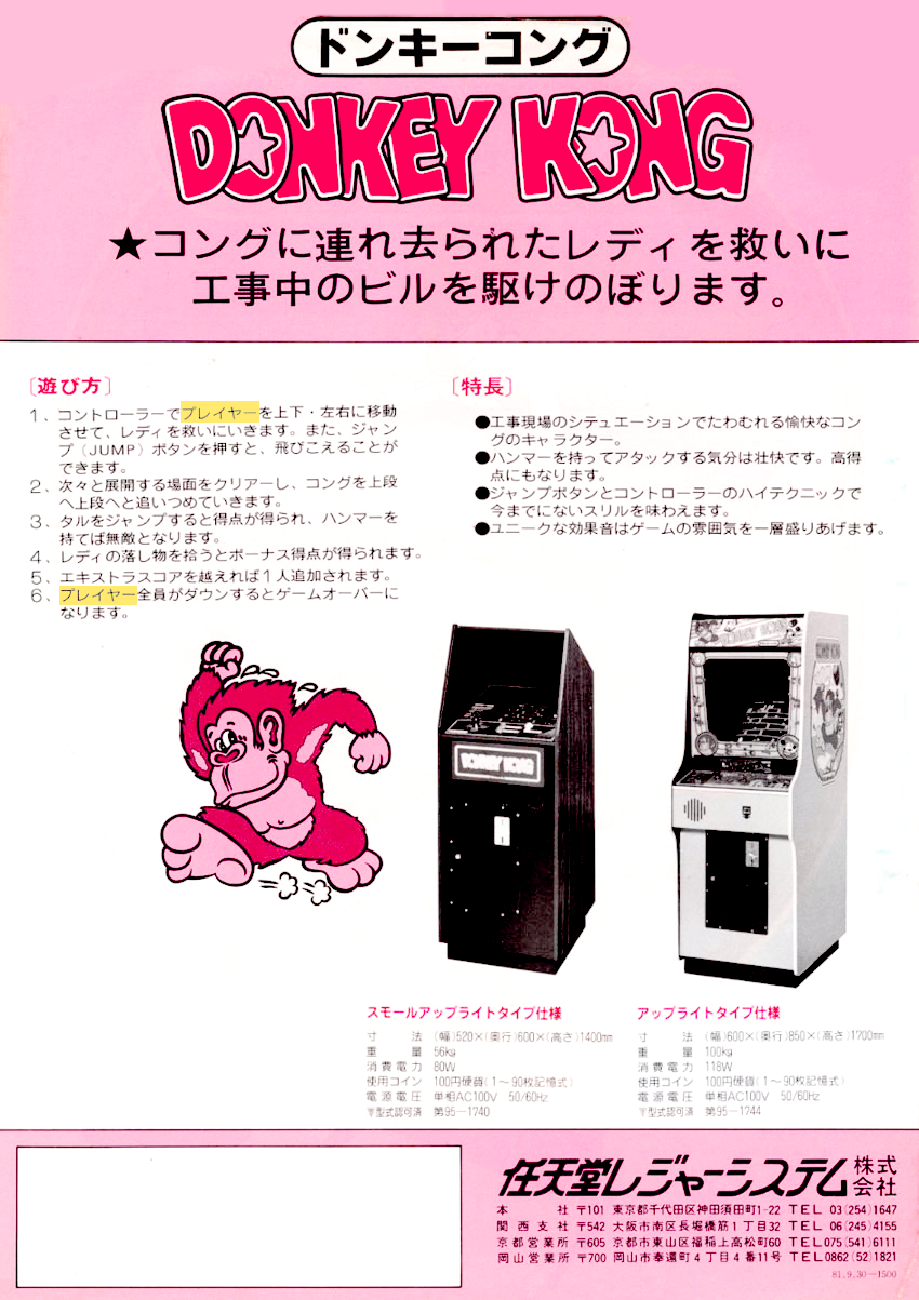
The first item is telling the reader that “the player” can be moved in one of four directions or be made to jump using the JUMP button. And the fifth one says that high scores will result in “additional players.” (Via the Arcade Flyer Archive.)
Weirdly, the names Jumpman and Mario both debuted with the western release of Donkey Kong, the former appearing on the cabinet decals and the latter appearing in the English-language flyer.
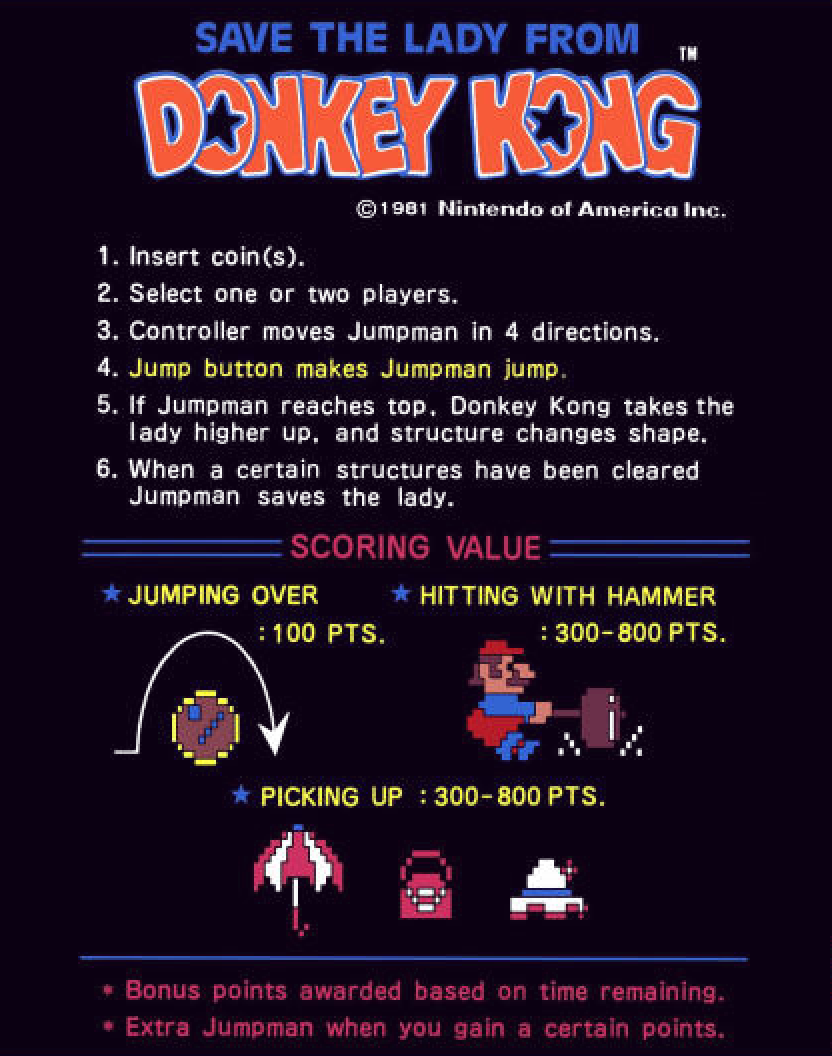
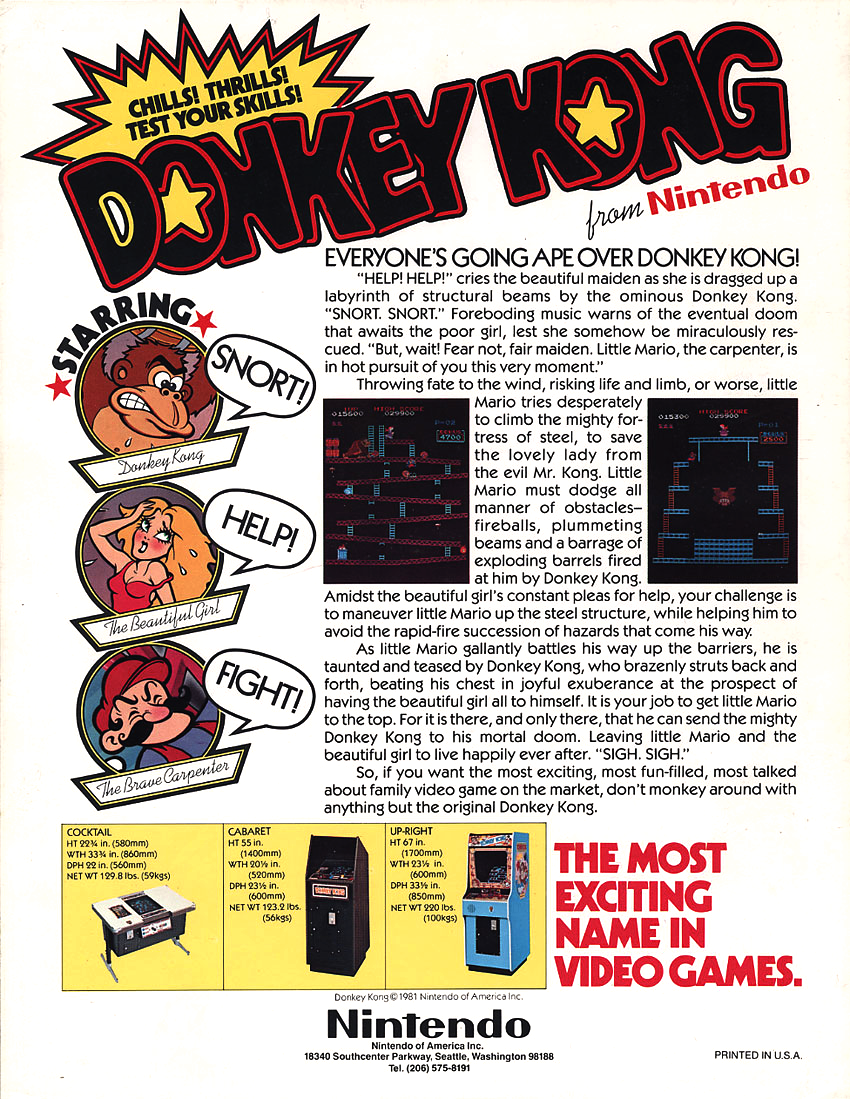
And the English flyer, which refers to our hero both as “little Mario” and “The Brave Carpenter.” (Via the Arcade Flyer Archive.)
The explanation for this would seem to stem from the name Jumpman (ジャンプマン or Janpuman) being attached to him before the game shipped from Japan to North America. Once it got to the U.S., some variation of one of the stories mentioned in the previous item resulted in the character being named Mario. By that point in the development process, however, only the flyer could be changed to reflect the new name — though at this point, he was referred to as Little Mario.
The name Mario wasn’t attached to the character in a Japanese release until the release of Donkey Kong Jr. in August 1982.
3. Mario had other preliminary “names” besides Jumpman.
Initially, Mario was Ossan (おっさん), which just means “middle-aged guy” in Japanese. In a 2009 Iwata Asks roundtable promoting New Super Mario Bros. Wii, Miyamoto explains that he came up with the second name, Mr. Video (ミスター・ビデオ or Misutā Bideo) because at the time he felt it was a “solid, imposing name,” though he later admitted that if he had stuck with that name, Mario “would have disappeared off the face of the earth.” It’s maybe worth noting that some Japanese renderings of this name, including in the original Japanese version of this Iwata Asks, write it out as Mr. Video Game (ミスター・ビデオゲーム or Misutā Bideogēmu). I’m not sure why English shortens it the way it does. Next came Jumpman and The Brave Carpenter and Little Mario and then just Mario after that, but curiously the Game & Watch version of Donkey Kong, released June 3, 1982, refers to Mario only as Rescue Man (救助マン or Kyūjo Man).
4. Ossan lived on, however.
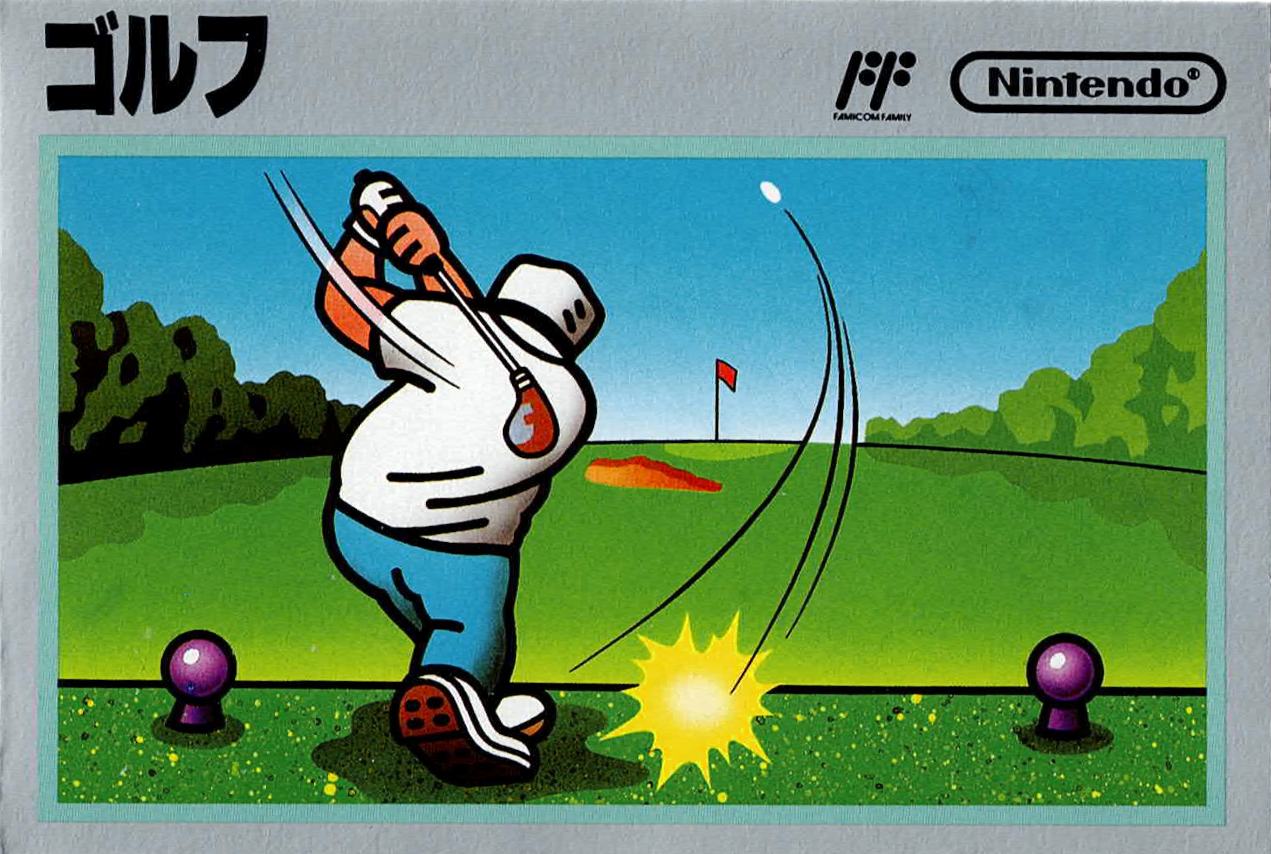
Of all the discarded names, only Ossan really found an extra life, so to speak. You might just think the mustachioed, middle-aged duffer in Nintendo’s 1984 Golf game is supposed to be Mario, and according to some text, he is. The box art for the North American version of the game even gives the pixelated version of the character the alternate red color scheme, which makes him look a lot more like Mario.
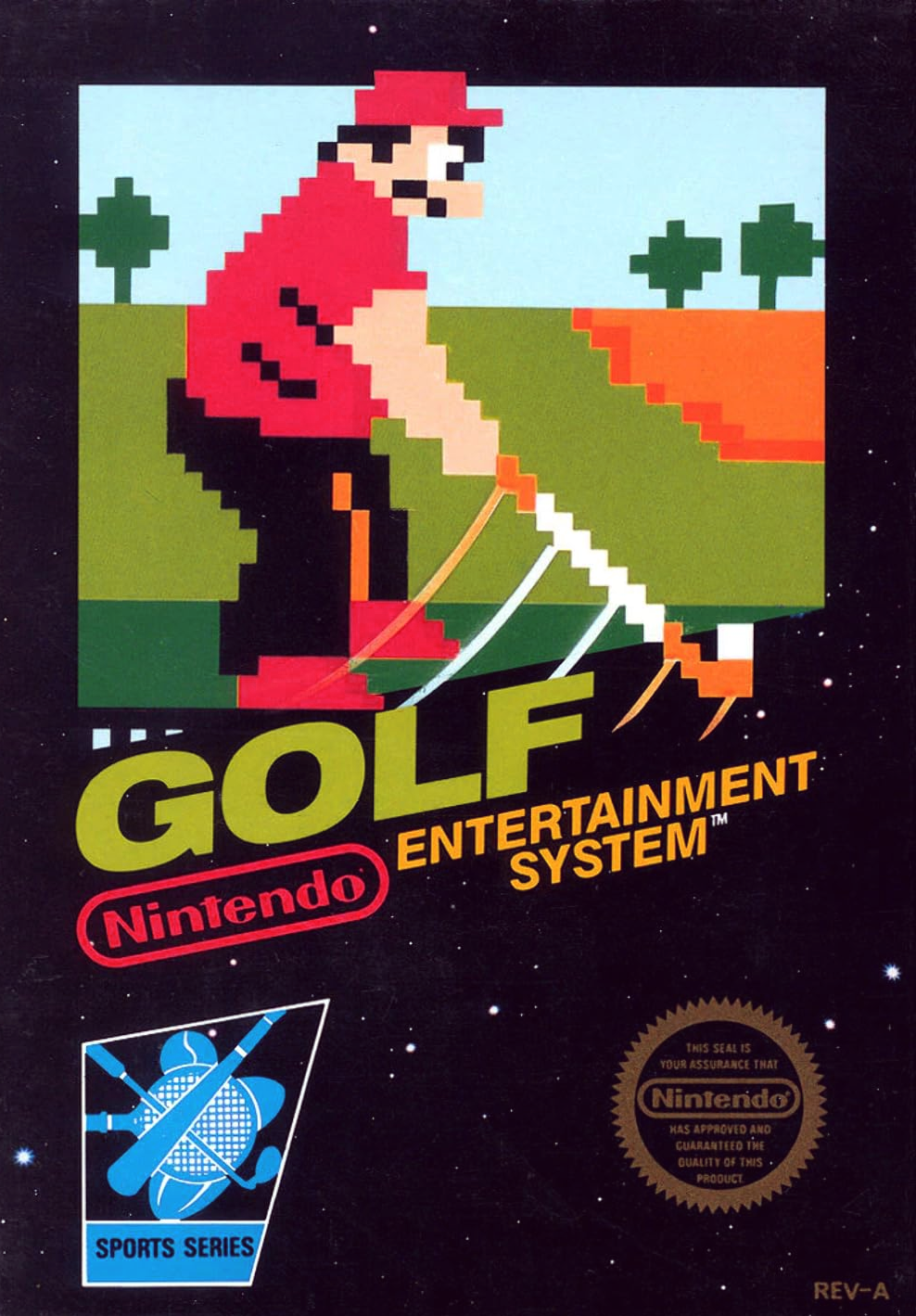
The Japanese version isn’t so clear, however, as it uses the more typical blue and white palette, and the character’s face is turned away, making it harder to tell if it’s actually supposed to be Mario.
However, Nintendo’s Japan-only nostalgia-fest Captain Rainbow, which was released for the Wii in 2008 and which takes place on an island populated with Nintendo bit-players, features that same golfer, but he is decidedly not Mario; he’s a different character named Ossan.
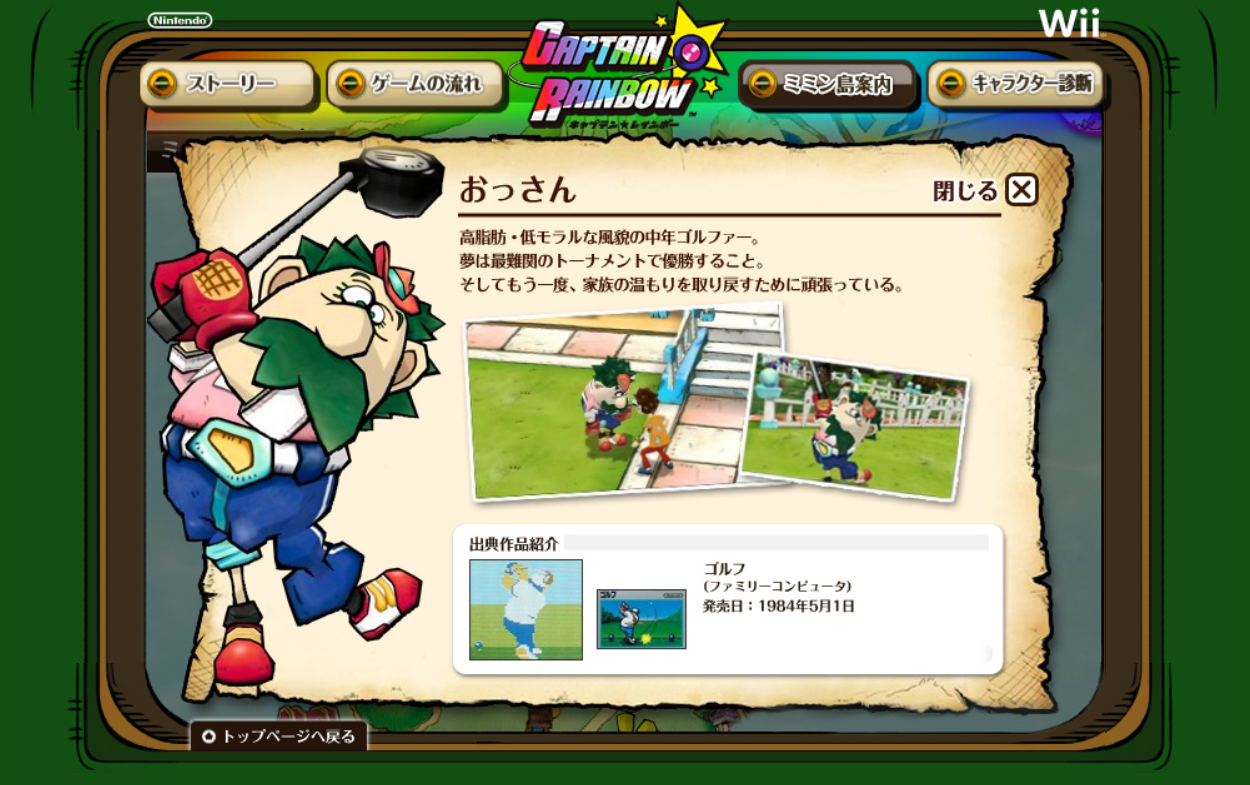
This will also be a trend throughout this piece; something being introduced as identical or nearly identical to an established thing, then differentiated over time.
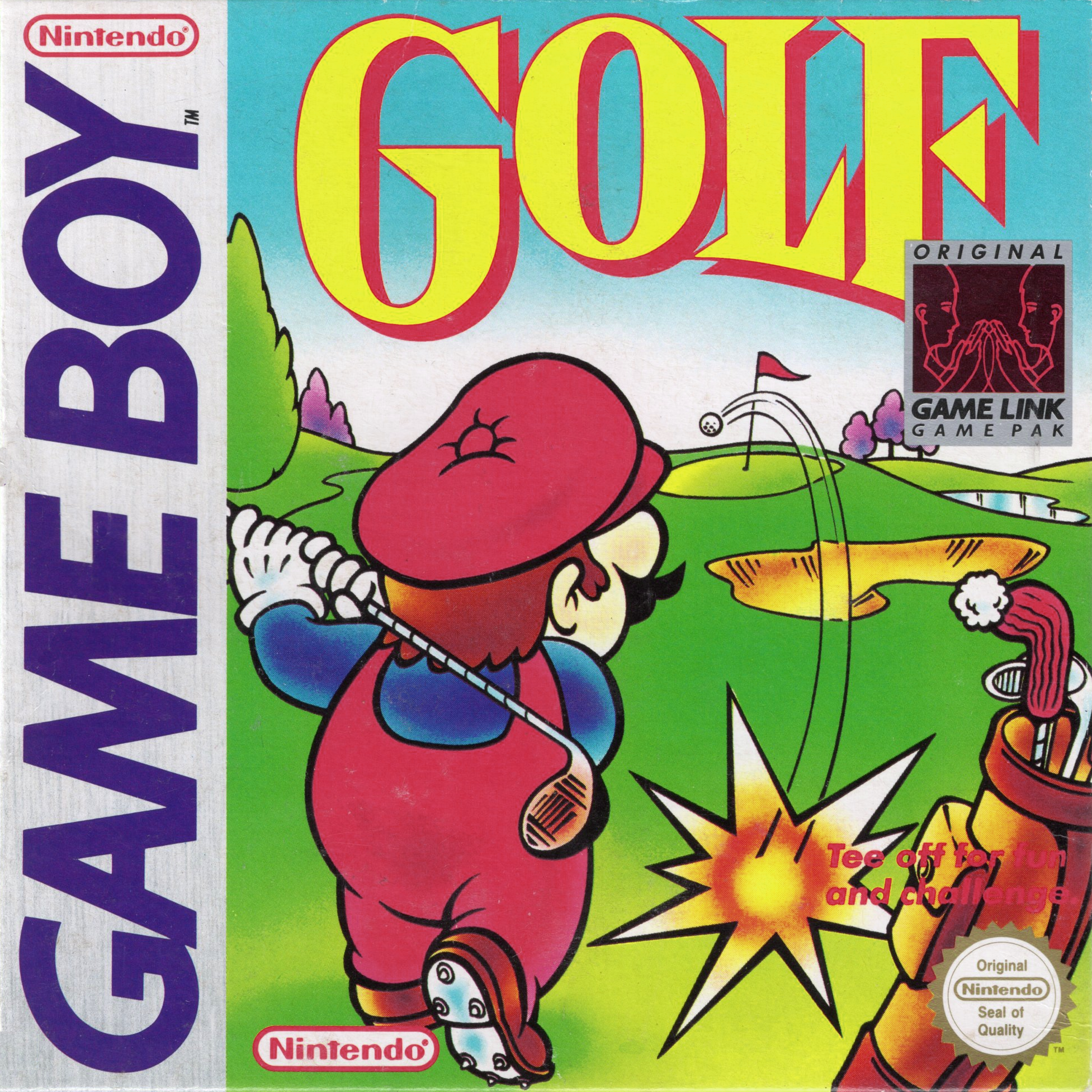
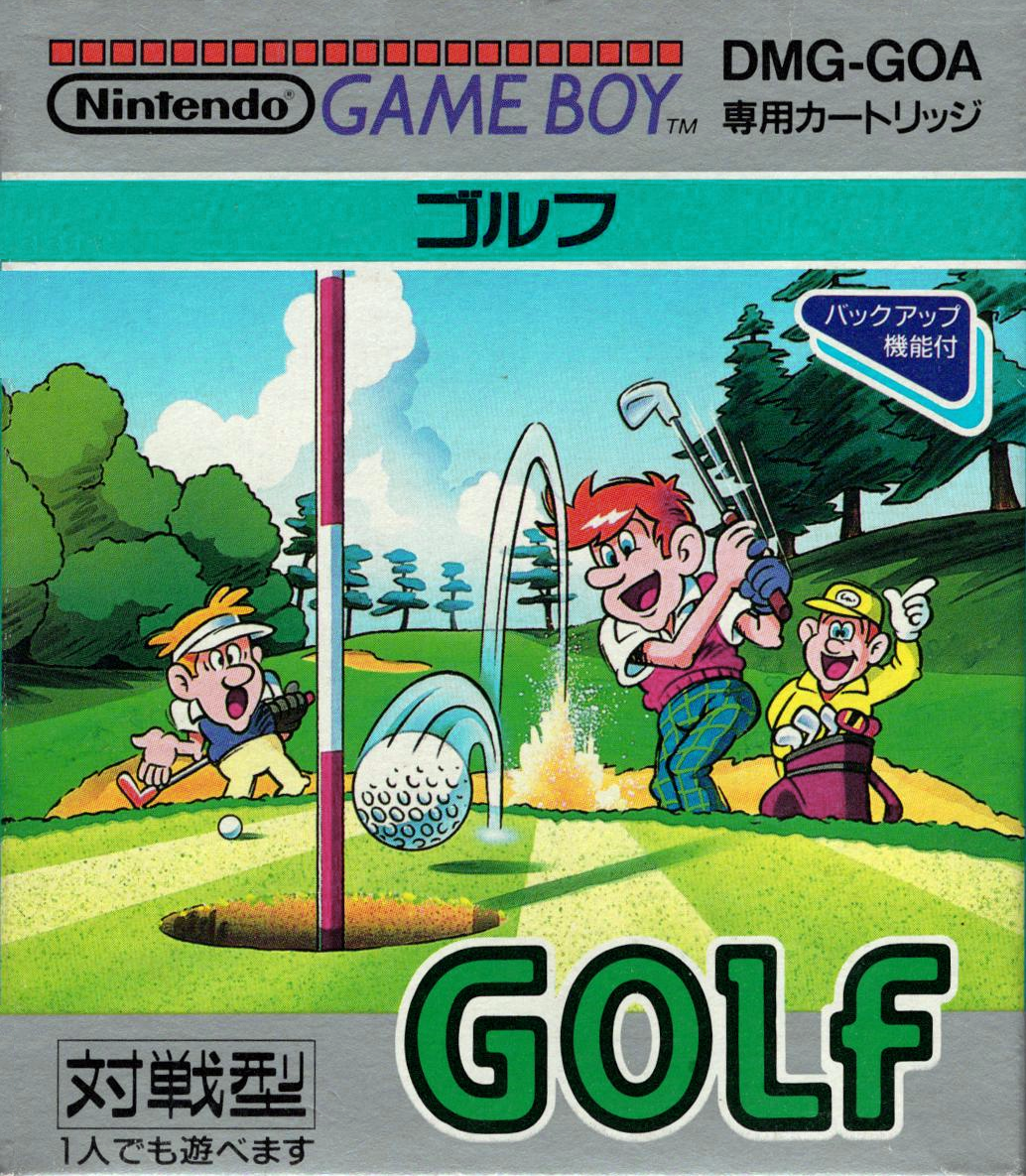
Oddly, the confusion about whether it’s Mario or some other mustachioed duffer in the original NES game is further muddied by the Game Boy follow-up, released in Japan in 1989 and in North America in 1990. The box art for the western release clearly shows that it’s Mario hitting the links, but the Japanese version shows a guy who is very much not Mario. He doesn’t even have a mustache.
5. It’s not clear what came first: the mustache or the Italian heritage.
Famously, the technical limitations of the day ended up defining Mario’s look. That 2009 Itwata Asks, for example, explains that Mario wears overalls over a contrasting shirt because that was a simple way to animate the movement of his arms back when Donkey Kong was being programmed. Similarly, Mario wears a hat so the programmers wouldn’t need to waste pixels depicting hair, and he has a mustache because that was an easy way to differentiate his nose from the rest of his face. It’s not stated explicitly, but it seems like Mario ended up with a big potato nose just because that’s how best a nose could be represented in a 16-by-16 sprite. Pauline’s considerably taller sprite in Donkey Kong, by contrast, uses a single pixel for her nose, and it barely looks like she even has a nose at all.
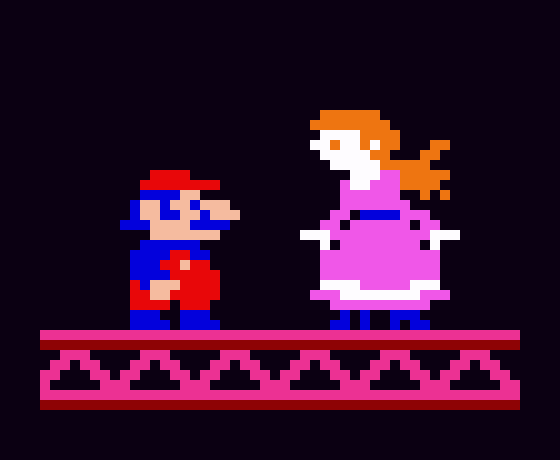
In a 2008 interview with Wired’s Chris Kohler, Miyamoto explained that Nintendo ended up regarding Mario as an Italian character because he had a mustache: “Because we, in the design process, had given him a mustache, then in the end we were like, ‘Oh, he's got a mustache. Well, let’s make him Italian.’” In case it needs to be said, there’s a stereotype that Italians and Italian-Americans have mustaches. Check any pizza box mascot for proof of this being alive and well today. What’s interesting about Miyamoto’s explanation is that once again Mario Segale is not mentioned. There’s a persistent belief online that Mario either got his mustache because Segale had one or was named Mario because his mustache made him look like Segale, but no one has ever said that Segale ever sported a mustache at all. Perhaps he wanted to buck Italian-American stereotypes.
However, that previously mentioned Nintendo Dream interview has Miyamoto remembering it essentially the opposite of what he said in the 2000 interview, with Mario’s Italian heritage always being part of his conception for the character and the mustache becoming part of the design as a result of that.
Miyamoto: I was already thinking of drawing an Italian. In Italy, there are many designers named Mr. Mario something-something, so the name Mario sounded natural.
Interviewer: You were drawing while imagining an Italian person.
Miyamoto: Yes, I was. I particularly like the art of Mordillo [an Italian illustrator]. His characters have big noses and mustaches.
Interviewer: Were you influenced by his work when you decided on Mario’s design?
Miyamoto: There is that, but that’s not all of it. There have always been a lot of characters that have big noses and mustaches. Like Don Gabacho from a show I like, Hyokori Hyotan Shima, and Professor Ochanomizu from Astro Boy. I suppose this influenced me to associate big noses and mustaches together. And so I drew Mario, imagining him as someone of Italian descent.
The publication incorrectly identifies Mordillo as Italian. He was actually Argentine, of Spanish descent. But it’s perhaps more notable that Miyamoto is incorrectly remembering Mordillo’s art. While all of his cartoon people do in fact have Mario-style potato noses, I actually couldn’t find any with mustaches.
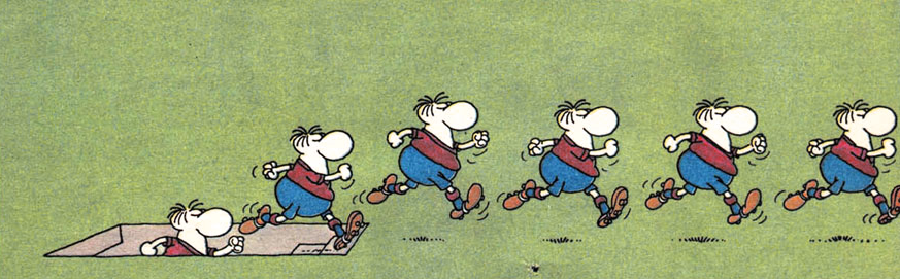
I’m sure some exist, but they’re not as prominent as Miyamoto claims. Perhaps Miyamoto is just Mario-pilled, but also perhaps his recollections aren’t always accurate, his status as Mario’s cultural custodian notwithstanding.
6. Mario’s mustache might link him to a previous Nintendo hero.
In that 2009 Iwata Asks, Miyamoto makes an interesting statement about the difficulty of drawing a mouth when you’re working with limited pixels: “If you draw a nose then a moustache, you don’t really know if it's a mouth or a moustache, and it saves pixels. … You don’t have to draw a mouth, which makes a big difference. You only need one pixel for the chin and if you draw two vertical pixels, you’ve got eyes that hopefully look quite cute.” It’s not stated outright, but it seems like Miyamoto might be alluding to difficulties drawing Mr. Jack, the player character in Sheriff, which was released in arcades in 1979 and for which Miyamoto was credited as the artist. In cabinet art for the game, the heroic sheriff character is shown with a tough guy scowl. The in-game sprite, however, just looks like he has a mustache.
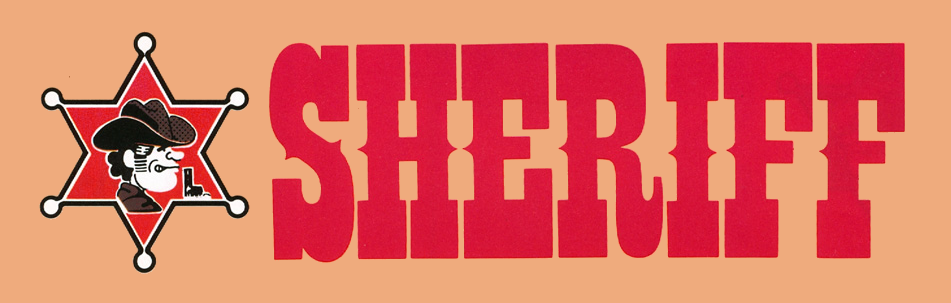
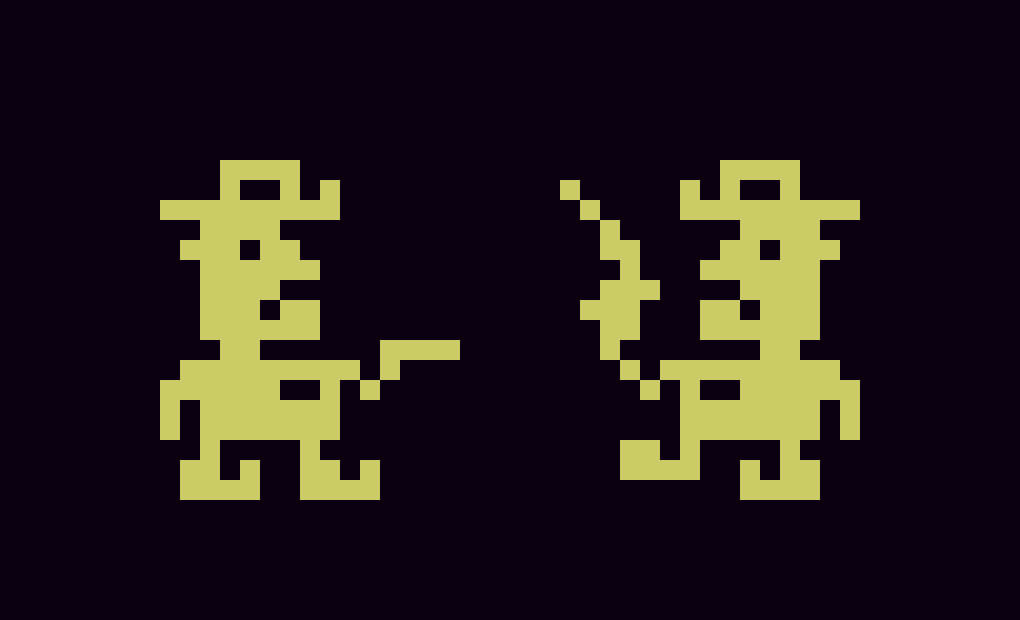
In this specific sense, this might make Mario a kind of “descendant” of the Sheriff character, but there’s an even more striking tie between Sheriff and another series regular I’ll get to in item no. 86, toward the end of this piece.
7. Mario’s time as a plumber was shorter than you’d think.
In the west, at least, the notion that Mario works as a plumber has lingered. I’m sure it’s reinforced to a degree by the live-action movie, the Super Mario Bros. Super Show! and the animated movie, which are all a lot more plumber-centric than the games have ever been. But Mario only got that job for the 1983 arcade game Mario Bros. Technically, it was just one of many blue-collar jobs that Mario held in those early years, and for what it’s worth, it’s never made clear in the actual game or in the accompanying literature that Mario and Luigi are playing in the sewer because they’re there to do plumbing work.
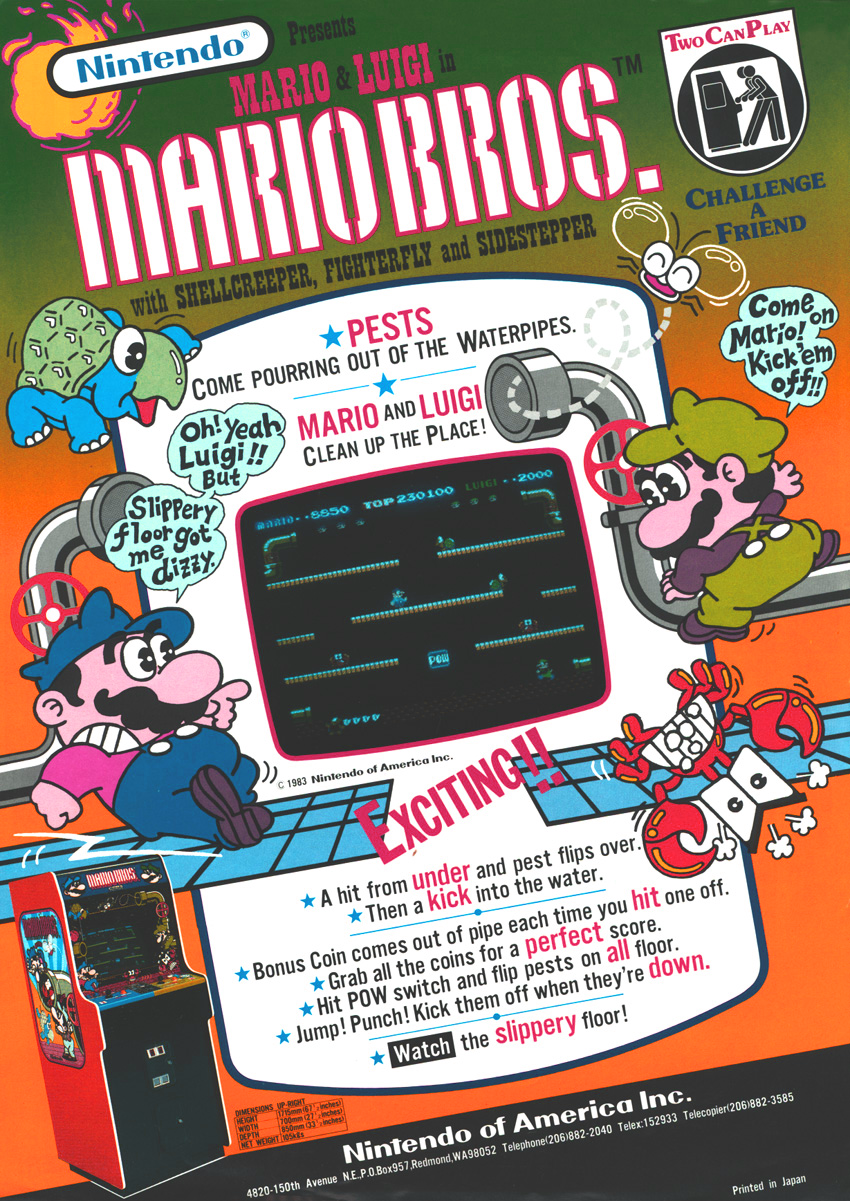
For whatever reason, it stops just short of calling the brothers plumbers. (Via the Arcade Flyer Archive.)
It’s not stated in the instruction booklet for the NES port of the game either. I’m actually looking into whether any other ports for the game actually do mention Mario and Luigi being plumbers.
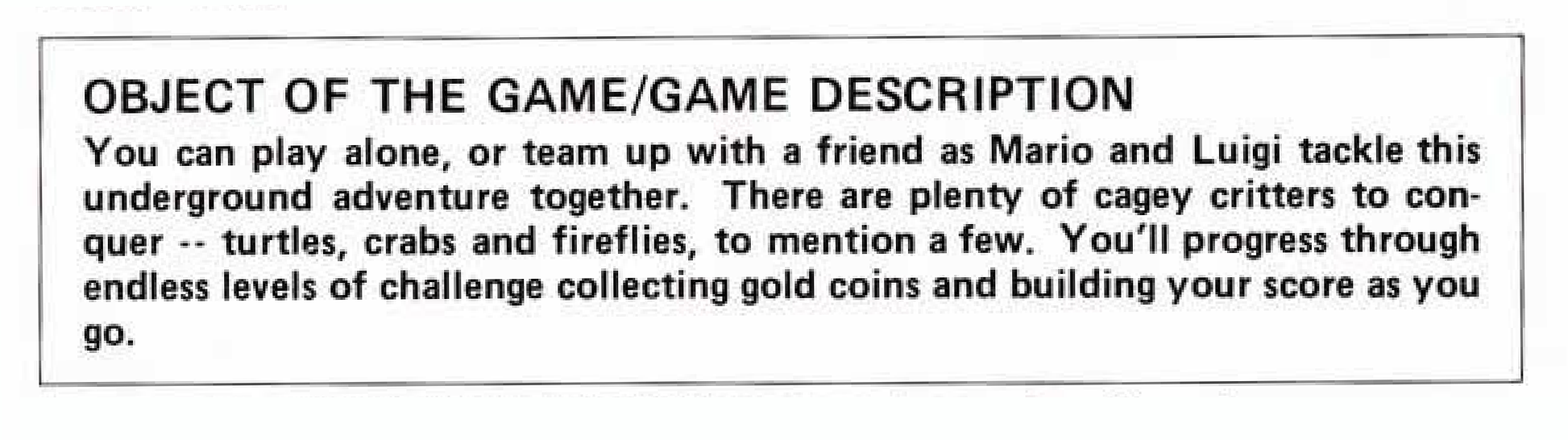
Profession acknowledgement notwithstanding, Mario Bros. introduced the green pipes that would end up becoming one of the series’ most iconic visual touches. The pipes continued in Super Mario Bros. and beyond, long after Nintendo games stopped referring to Mario as any kind of plumber.
The promo flyers for Donkey Kong explicitly identify Mario as a carpenter, hence why the setting is a construction site. And later games made Mario a demolition worker (Wrecking Crew), a racecar driver (Famicom Grand Prix) or even a medical professional (Dr. Mario), and I can recall people reacting to new jobs with some variation of “Isn’t he a plumber?” Those same people were aghast in 2017 when Nintendo’s Japanese site seemed to indicate that Mario’s plumbing days were behind him. His bio at the time had been changed to say, “All around sporty, whether it’s tennis or baseball, soccer or car racing, [Mario] does everything cool. As a matter of fact, he also seems to have worked as a plumber a long time ago.”
For what it’s worth, Miyamoto had maintained in more than one interview that Mario was always supposed to be an everyman who could work as any given number of professions. Speaking to BBC Radio 4’s Front Row in 2009, Miyamoto answered the question of why he created a heroic character with such ordinary work life: “I don’t like the idea of a perfect hero. I prefer ordinary citizens trying to do something really good for society. I’d be embarrassed to have a perfect hero. I like the idea of a middle-aged, ordinary man doing something nice for other people.”
And in a 2012 interview with Game Informer, he admitted that Mario’s stint as a doctor would seem to be the outlier — and perhaps someone whose medical advice should not be trusted? “Generally, it’s that he’s more on the blue-collar side. He's hard-working, and certainly much more physical in nature,” Miyamoto said. “So I think that a doctor is sort of an unexpected and perhaps unbelievable role for Mario. Perhaps the Dr. Mario you’re thinking of was maybe, in some way, not necessarily legitimate.”
EDIT: After this post went live, it was brought to my attention via Bluesky that according a loading screen in Super Mario Bros. Wonder, Mario and Luigi actually are still plumbers, all previous discussion notwithstanding.
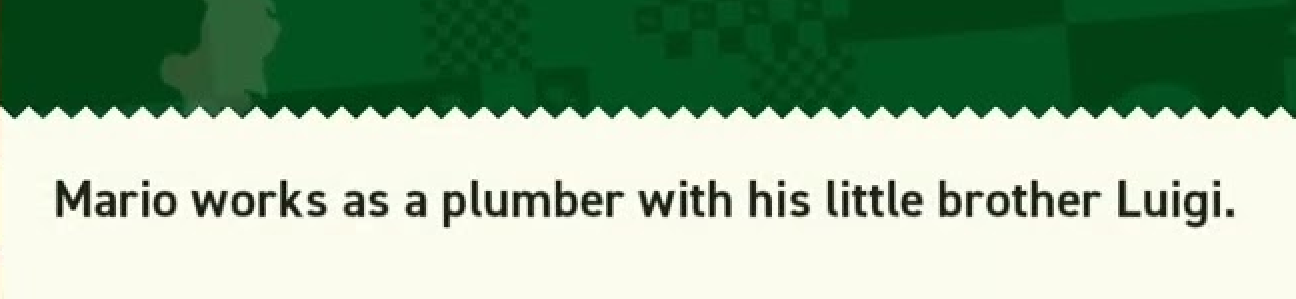
And no, it’s not unique to the English localization of the game. The original Japanese version has a loading screen tip that reads, “マリオは 弟のルイージと一緒に う配管工の仕事をしている,” essentially stating the same information.
8. That said, Mario has been seen working as a plumber in a video game — but only twice.
The brothers’ plumbing backghround only becomes a plot point once in an actual game. Early in 2003’s Mario & Luigi: Superstar Saga, they’re suspected of being intruders in Beanbean Kingdom, which neighbors the Mushroom Kingdom. In order to be sure that Mario and Luigi are who they say they are, Lady Lima asks the boys to repair the castle’s plumbing system. It’s a connection that’s very explicit in the English version of the game.
This exists in the original Japanese version as well, just not quite as explicit. Lady Lima still asks them to repair the pipes to prove their identities, but she does not outright say “because you two are famously plumbers.” Either way, this sewer area is populated by Fighter Flies and Spinies, so it’s clearly this game’s not to the fact that the original Mario Bros. being about plumbing, in a way.
And then 2013’s Super Mario 3D World kicks off with Mario and Luigi repairing a pipe using hammers and wrenches, then ultimately going down the pipe and entering a new kingdom where Bowser is wreaking havoc.
It’s a literalization of how I always imagined Mario and Luigi ending up in the Mushroom Kingdom in the original Super Mario Bros., perhaps with the pipes seen in Mario Bros. leading them to this new fantasy location. However, the official story stated in the instruction manual says nothing of the sort.
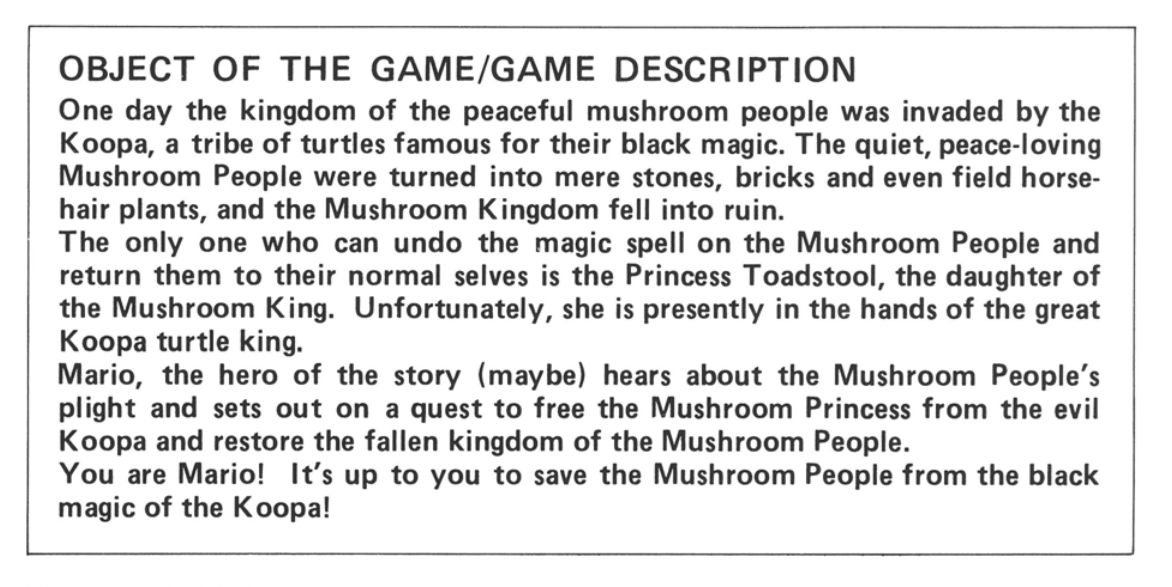
The original English script to Super Mario RPG includes references to Mario and Luigi both being plumbers, but perhaps tellingly, these are eliminated in the revised 2023 remake. In the Star Hill area of the game, Mario can read the wishes of various characters in the game, and once seems to be Luigi’s.
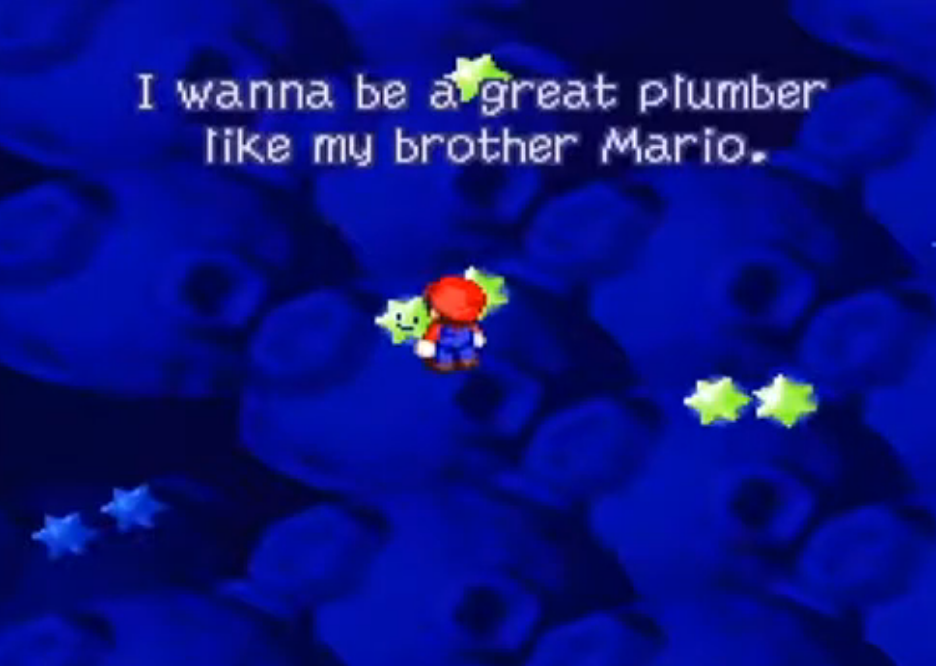
The 2023 remake removes mentions of plumbing, however, though it does fix the missing comma.
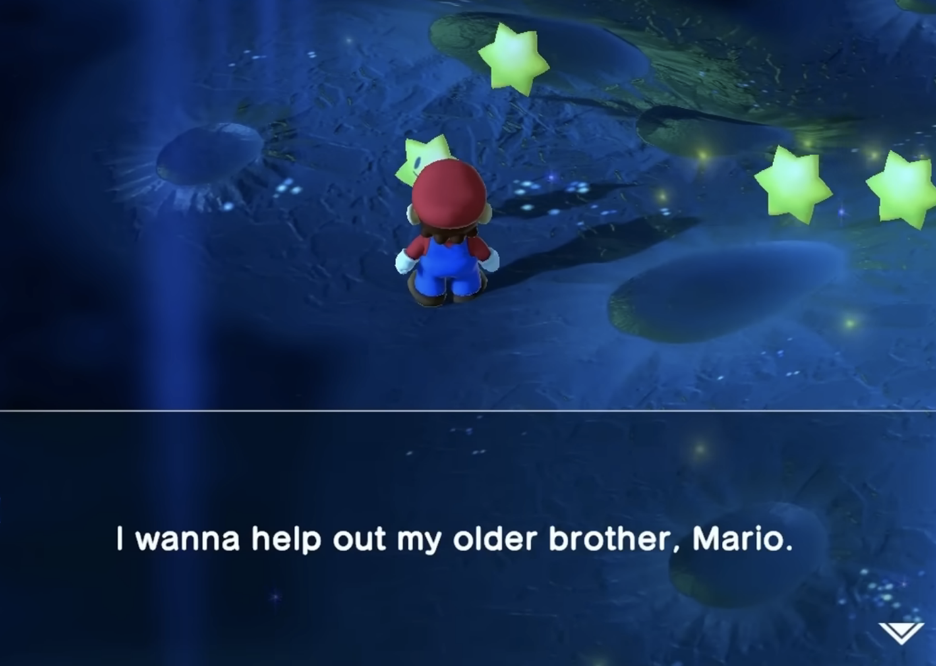
And that’s more or less how it’s stated in the original Japanese and the Japanese version of the remake — no plumbing.
9. Osamu Tezuka’s “star system” is a great way to explain the series’ inconsistent canon.
In the 2009 Iwata Asks, Miyamoto recalls how he’d planned that the character he was still calling Mr. Video would show up in all his games, and his first example is how director Alfred Hitchcock would make a cameo in all his films. That’s instructive to a degree, as Mario would make cameos in games like Pinball and Tennis, but the next example Miyamoto offers is maybe even more helpful to understanding how he and Nintendo in general understood Mario and his friends as they appeared in one game and then another.
Miyamoto points to the roster of characters appearing in the work of manga master Osamu Tezuka. Astro Boy, for example, is the main protagonist of his own series, but he makes cameos in Tezuka’s other manga, such as Black Jack, and not always as the same specific character readers would have come to know in the Astro Boy comics even if he might look the same. In her essay for the 2008 book Japanese Visual Culture, Susanne Phillipps explains that Tezuka viewed his characters as members of an ensemble.
An unpublished manuscript of Tezuka’s… hints that he actually imagined his characters to be actors that he hired. He had drawn a lineup of their faces, provided a short description of them, a curriculum vitae of their acting careers (who worked when for which studio) and a salary chart of the fees that should receive for appearing in a manga.
I’m pretty sure Nintendo hasn’t done this with Mario and company, but regardless this squares neatly with other comments Miyamoto has made about any kind of canon linking the Super Mario games and their spinoffs. For example, in that Game Informer interview, he offers a similar explanation to a question about why Bowser is a villain in some games but is nonetheless welcomed to participate in go-kart races or sports tournaments in others.
If you’re familiar with things like Popeye and some of the old comic characters, you would oftentimes see this cast of characters that takes on different roles depending on the comic or cartoon. They might be a businessman in one or a pirate in another. Depending on the story that was being told, they would change roles. So, to a certain degree, I look at our characters in a similar way and feel that they can take on different roles in different games. It's more like they’re one big family, or maybe a troupe of actors.
Not only do I see this approach as a means to handwave away various inconsistencies between one game and the next, but also gives context to the various ways Super Mario games have been presented as one form or theater or another. (See item no. 72 for more on this — but no, I don’t think it’s merely meant to be a stage play, regardless of how Super Mario Bros. 3 makes it look.)
10. Of course, there’s the Popeye thing.
At this point, it’s fairly well known that Mario, Donkey Kong and Pauline were created as substitutes for Popeye, Bluto (technically Brutus) and Olive Oyl once Nintendo didn’t end up making its first attempt at a Popeye game. The Popeye influence still remains in the finalized version of Donkey Kong, actually, with the neon pink girders from the original arcade game being inspired by the ones in the 1934 Popeye cartoon “A Dream Walking.”
But also Popeye’s reliance on spinach to grow his muscles may actually be responsible for the concept of power-ups — not just in Super Mario games but in video games in general. I wrote about this at length in a 2022 piece, “How Popeye Changed Video Games,” if you want to get into it — and you should, because you’re probably underestimating the effect the sailor man has had on pop culture, video game-related or otherwise.
11. But there’s also this *other* Popeye thing.
In this tour of Mario’s strange history, there are going to be a few instances of pop culture artifacts that I just cannot explain and that no one else can either, as far as I know. And one of them is the March 1980 issue of the Japanese men’s lifestyle publication Popeye — which, yes, was named for the cartoon character.
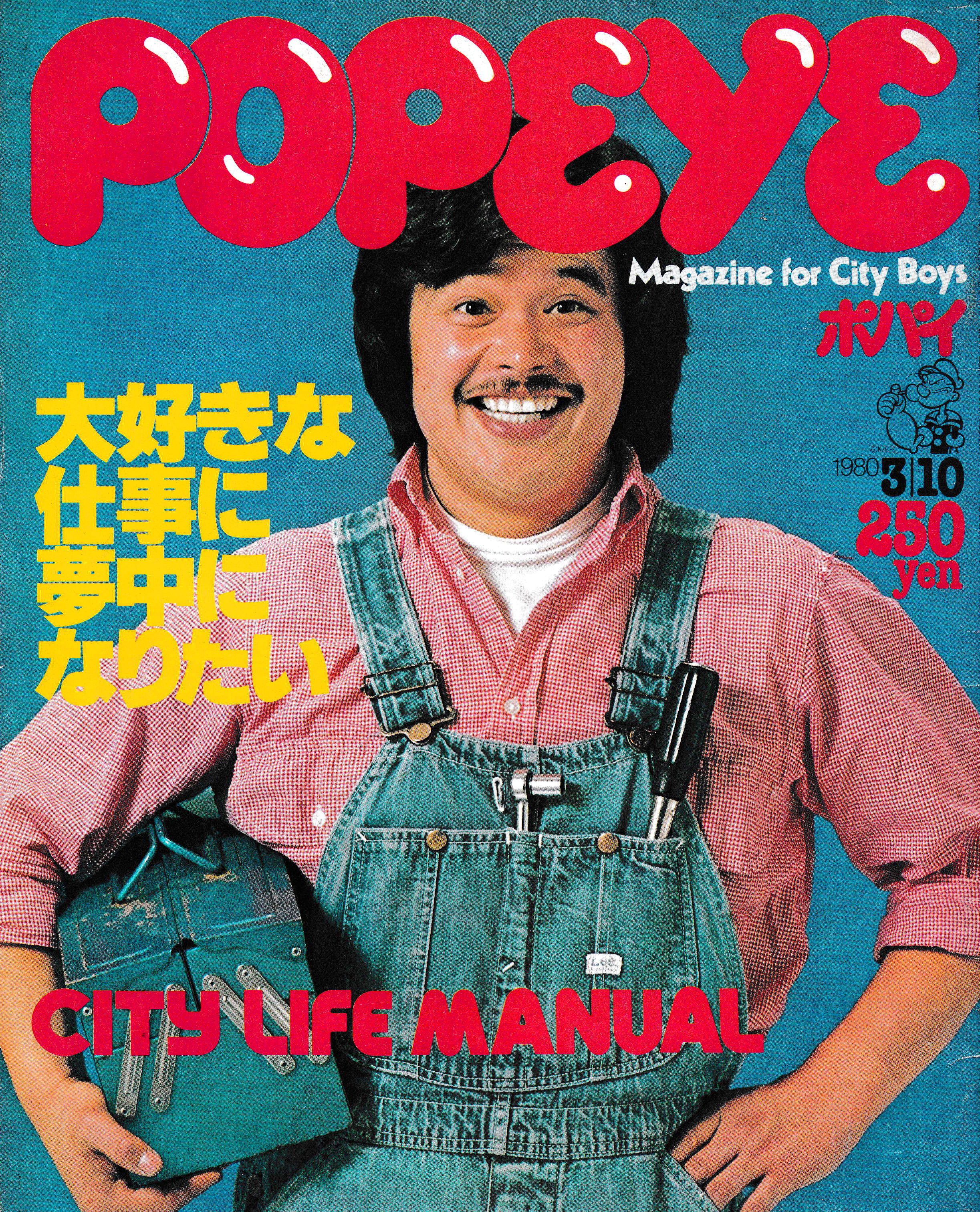
Of course, this cover image predates Mario’s debut by a year, though that does likely put this issue out around the time Nintendo would have been finalizing Mario’s appearance. Officially, we already have technical reasons for why Mario ended up with a mustache and overalls, but those don’t discount the idea that this cover boy could have influenced how Miyamoto decided to circumvent those graphical limitations.
12. The pizza parlor origin story for Luigi’s is probably an urban legend.
Along similar lines to the angry landlord story explaining Mario’s name, there’s a commonlyrepeatedexplanation for Luigi’s name coming from a Redmond, Washington, pizza parlor called Mario & Luigi’s. And while that would seem plausible, no one has ever reported any evidence of an establishment by that name existing near Nintendo’s west coast headquarters. If you have any proof of such a pizza parlor existing around the time Luigi was introduced, post it online. You’d be the first.
13. Yes, Luigi was “similar,” but that’s apparently not the origin of his name.
In that aforementioned 1986 Reuters article, Miyamoto notes how Luigi’s name sounds like the Japanese word 類似 or ruiji, meaning “similarity” or “resemblance,” without explicitly stating that this word is how Luigi got his name. But in the 2020 Nintendo Dream interview, Miyamoto seems to indicate that this is just a happy coincidence.
It’s often said that Luigi got his name because he “looks just like Mario,” [but] actually I was thinking of an Italian name that would be the most natural for someone alongside Mario. There are many designers named Mr. Luigi something-something, so I went with Luigi.
It probably goes without saying, but the ruiji-“similarity” rumor came up so often in the past because for much of Luigi’s early existence, he looked identical to Mario, just with a different color scheme. He didn’t become the taller, lankier brother until Famicom Grand Prix: 3D Hot Rally was released in April 1988. And while he got a unique sprite in the western Super Mario Bros. 2, it took until June 14, 1989, for Luigi to finally look different from Mario in a game that actually came out in Japan — and even then, it was only because the title in question, the Game Boy Tetris, was forced to do it as a result of the portable’s monochrome palette.
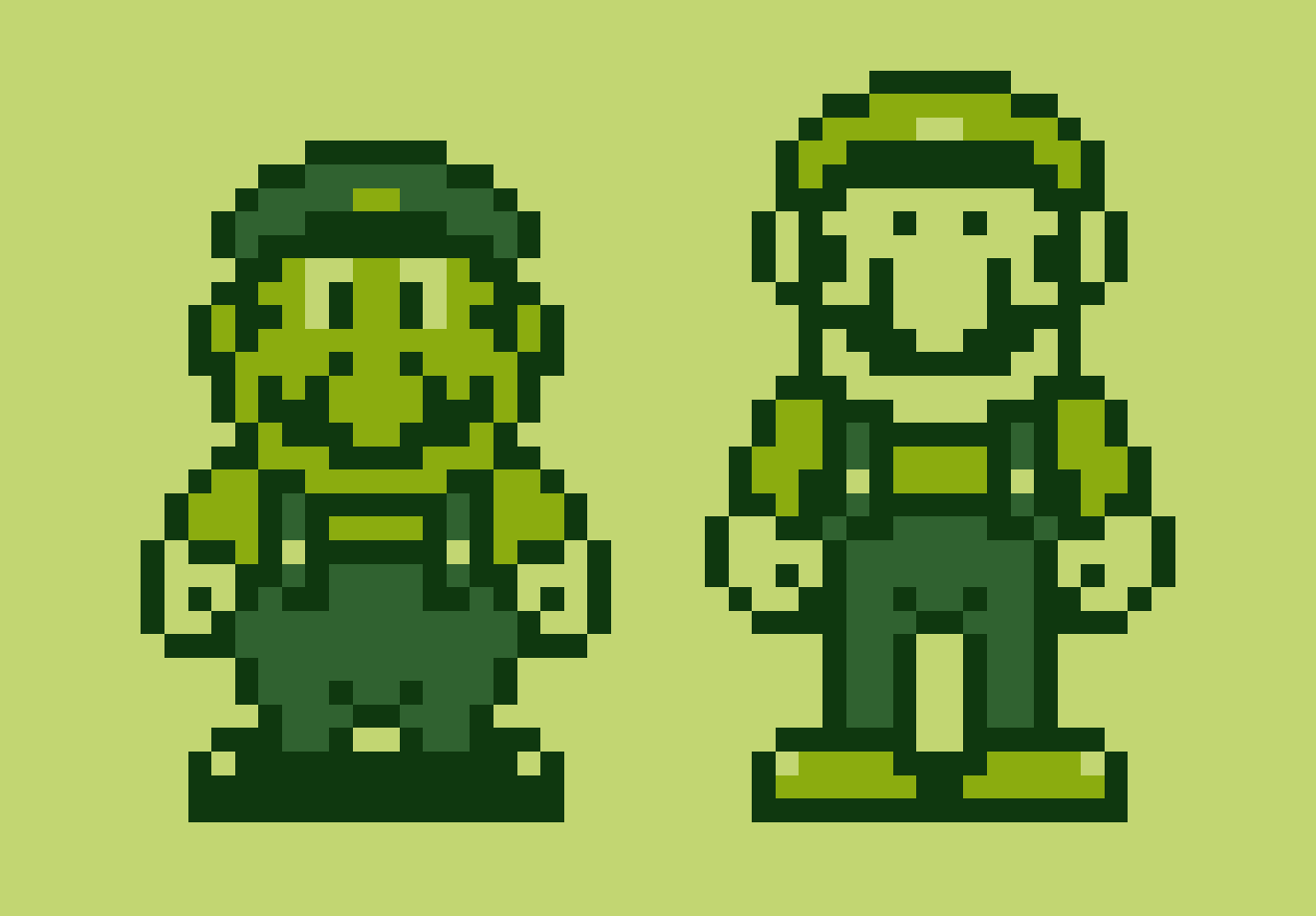
I’ve got an entire post devoted to Luigi’s gradual evolution, BTW.
14. Mario might sound “round,” but he was never supposed to be “big.”
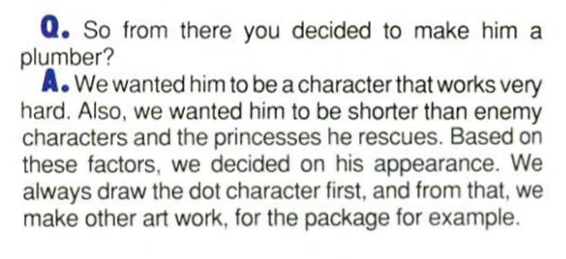
Luigi becoming the skinny brother meant that Mario became the stouter of the two. And that has led some people to point to the Japanese word まるい or marui, meaning “round,” as being a possible origin of his name. It sort of makes sense now, I suppose, but the theory falls apart when you keep in mind that Mario got his name during the Donkey Kong era, when Nintendo’s English-language materials were still referring to him as “Little Mario.” The idea that Mario was small existed in Japan as well. In Nintendo Power’s 1991 Mario Mania player’s guide, for example, Miyamoto says explicitly that being short of stature was one of Mario’s key physical characteristics.
In the original Super Mario Bros., the default, “regular” Mario was the one that Peach towered over. Mario only got to be taller than her if he snagged a mushroom and doubled his size. Fairly quickly afterward, however, Nintendo started making Mario’s taller, powered-up version the default version, but the size disparity remains nonetheless. The idea that Mario should be short compared to “normal” humanoid characters explains why I really dig how the art for Super Mario Bros. Deluxe, the 1999 Game Boy Color remake of the original game, actually gave Peach two different poses to illustrate the height difference between her and Mario versus the one between her and Luigi.
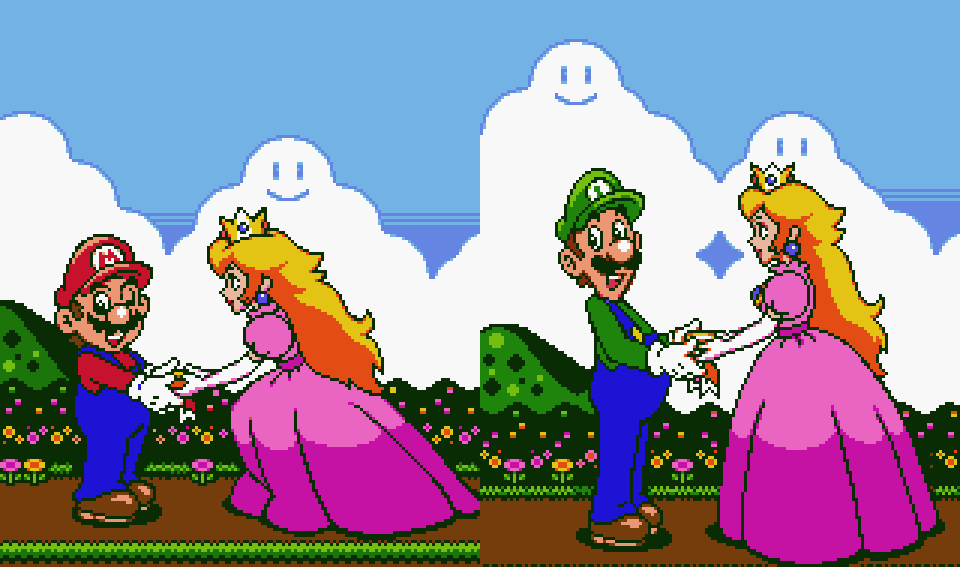
It’s not even just that Peach kneels to get down to Mario’s level. The “camera” is also tilted as if the photographer were trying to minimize the height difference, making the hills in the background appear taller. This is some high comedy right here.
And while spinoffs tend to even out the height differences to a degree, this is an aspect of Mario that has been preserved in more recent games. It’s the reason why Pauline and her New Donk City constituents stand nearly twice as tall in Super Mario Odyssey.
But while Nintendo’s official position is that Mario is the short one and not the round one, the company does offer some tacit confirmation that the whole marui thing is nonetheless accurate: Wario and Waluigi. These two are supposed to be distorted exaggerations of Mario and Luigi. Whereas Mario is stockier by comparison to Luigi, Wario is a big fat guy — and was that on his own for years before Waluigi showed up to make the contrast even more noticeable. And when Waluigi did finally join the crew, he outdid Luigi in the tall and skinny department by being a full-on gangly weirdo scarecrow.
15. There was a real-life Super Mario pipe somewhere in Kyoto.
You may have noticed that it’s often difficult to tie elements of the Super Mario series to a precise, agreed-upon origin. Well, one series element that’s given a rather concrete explanation is the green pipe that debuted in 1983’s Mario Bros. and has been used in basically every Mario game sense. In the 2009 Iwata Asks, Miyamoto demonstrates remarkable detail and depth in describing the pipe’s origin.
Iwata: How did you come up with the idea of having pipes in the first place?
Miyamoto: It comes from manga. … If you read old comic books, there will always be waste ground with pipes lying around.
Iwata: You’re right! (laughs)
Miyamoto: So the idea that you could get inside pipes when you see them was one that seemed very natural to me. Then when I was making Mario Bros., I realized that if all the turtles that emerged were to fall down to the bottom of the screen, they’d end up piled up there, which would be no good.
Iwata: The bottom of the screen would become turtle-ridden! (laughs)
Miyamoto: That's why I thought that in a closed-off space, we needed the same turtles to come and go. As the left and right of the screen were connected…
Iwata: If Mario went off the right of the screen, he would appear again from the left, wouldn't he?
Miyamoto: Right. But even with that in mind, having the top and bottom of the screen connected in the same way would have been somewhat odd. Then, on the way home from the office, I spied a concrete wall in a residential area which had a number of drainage pipes coming out of it. I thought: "I can use those!" (laughs) It's well established that something will emerge from a pipe and then go back into it.
Iwata: So that’s how you made it so the Koopa Troopas that come out of the pipe at the top will go back into the pipe at the bottom. Just out of interest, why did you decide to make the pipes green? … Pipes would normally be grey. I don't believe you’ll often find green pipes.
Miyamoto: Well, that’s the first time I’ve been asked that one! (laughs) I don’t really remember the reason why we made them green, but there weren’t that many colors you could use in video games back then. … Of those colors, blue was very bright and beautiful. Green was also very nice when you used two different tones. Those were the things we considered when designing the look of the game. So if we were using two tones together, green was the best color to have. We didn’t make the pipes green because they had to be the same color as the turtles’ shells or anything like that.
So there you go. Yes, it does seem like it’s impossible to get a straight answer about the origin of many things Super Mario-related. And it often is, but not in the specific case of the origin of the pipes and why they are green.
Part Two >
Navigation:
Part One (1-15): Mario and Luigi origins / Donkey Kong and Mario Bros.
Part Two (16-30): Bowser, Peach and Toad / Super Mario Bros.
Part Three (31-45): The enemies of Super Mario Bros.
Part Four (46-60): Super Mario Bros. miscellany / Super Mario Bros. 2
Part Five: (61-75): Super Mario Bros. 3 and Super Mario World
Part Six (76-90): Yoshi and Donkey Kong (and friends)
Part Seven (91-101): Various beloved supporting characters and also Stanley the Bugman
Part Eight (102–116): A sort of junk drawer including Peach’s dad, Bowser’s wife and the infamous field horsehair plants