

Mario 101: Part Three

31: The lowly Goomba is a marvel of ingenuity.
Despite being encountered first in Super Mario Bros., the mushroom who famously betrayed the Mushroom Kingdom was the final enemy character created. In a 2012 Iwata Asks promoting New Super Mario Bros. U, Takashi Tezuka recalled how the visual assets for the original game were designed to conserve space as much as possible. For example, the white clouds and green bushes that appear in the background are the same graphical element, just recolored, hence NeoGAF’s cloudbush thread. Near the end of work on the game, Tezuka recalls, the team realized that because it takes two steps to kill a Koopa Troopa — one to stomp it into its shell and a second to kick the shell away — there should be an enemy that only required one hit. Thus, the Goomba was born. But because scant memory remained this far into development, the little guy was given only a single frame of animation, with one foot drawn bigger than the other. Flipping that frame horizontally made it look like the Goomba was moving despite having just the one animation frame, and its wobbly walk has remained a part of its existence in every subsequent Super Mairo game.
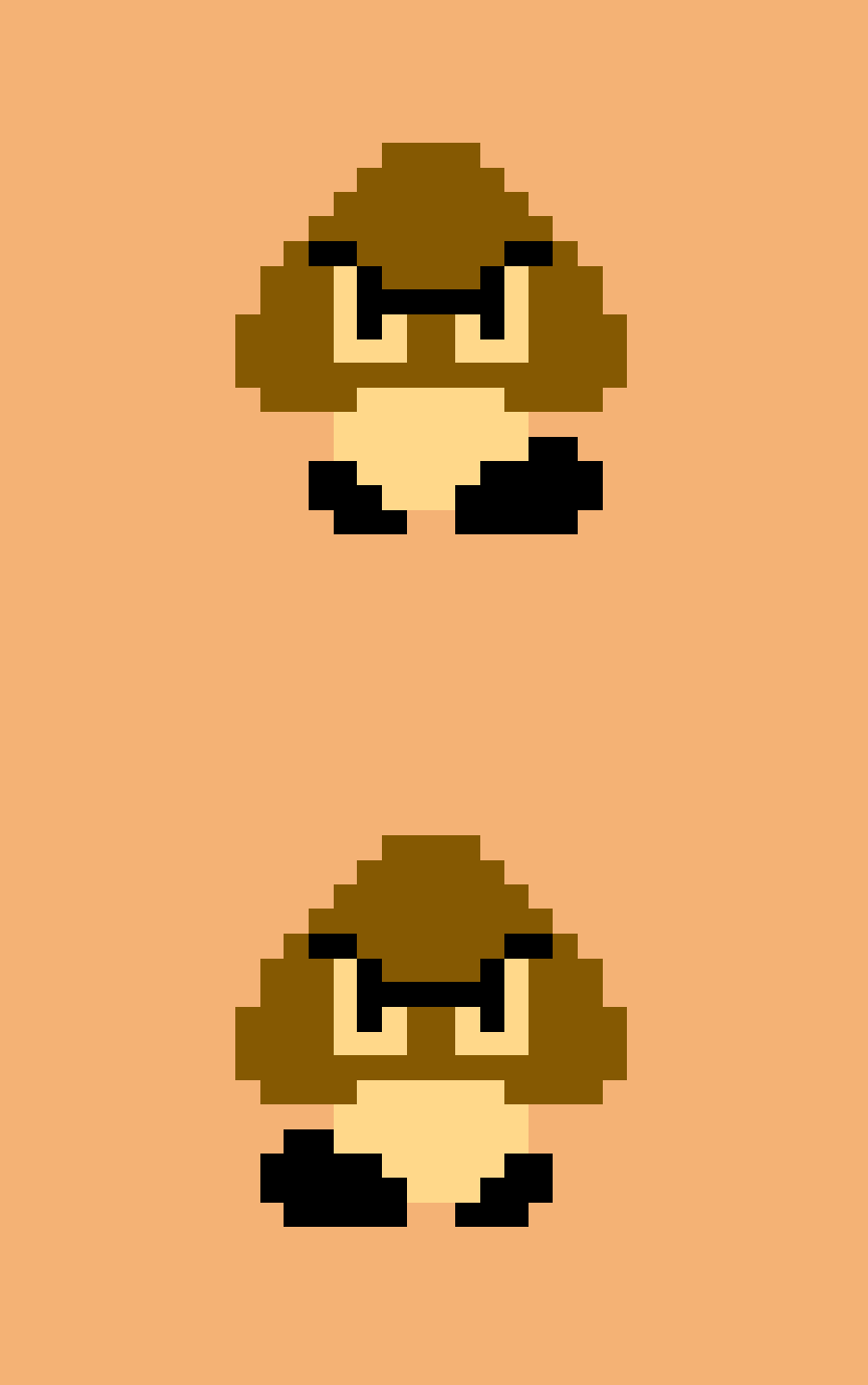
32: The Goomba is, in fact, a mushroom.
This might seem like a real “no duh,” but it’s not, I swear.
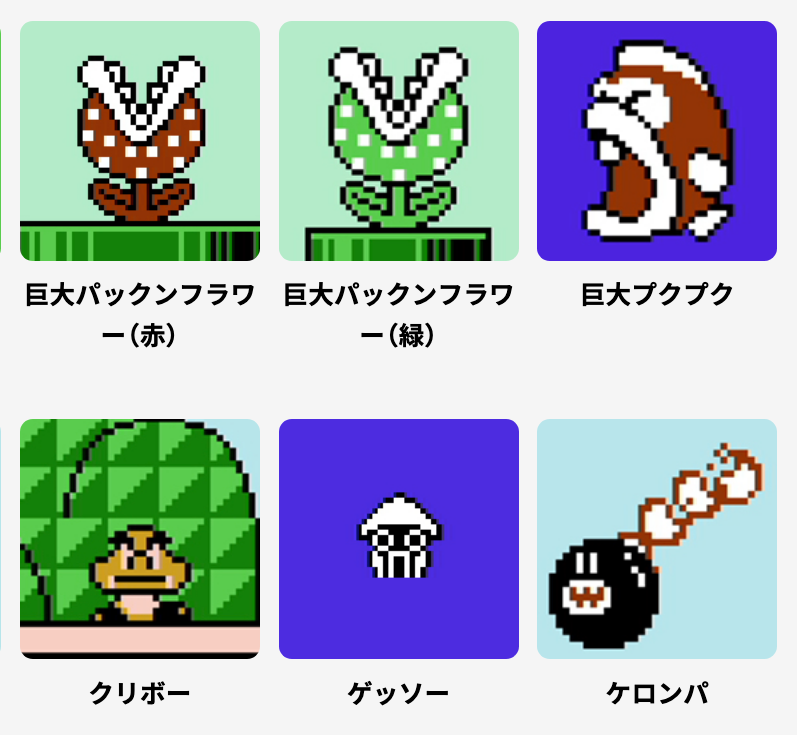
The Japanese name for the Goomba, クリボー or Kuribō, essentially means “chestnut guy” even though the characters were never meant to be chestnuts. In fact, in a 2012 Iwata Asks, they’re specified as being shiitake mushrooms. Once they were implemented in the game, however, someone decided that their brown, roundish head made them look like chestnuts, and the name stuck.
The legend of the walking chestnut refused to die, however. Super Mario World introduced a new variation of the Goomba that looks more like a chestnut than a mushroom. They’ve got rounder heads and, most notably, they lack the stem separating their heads from their feet.
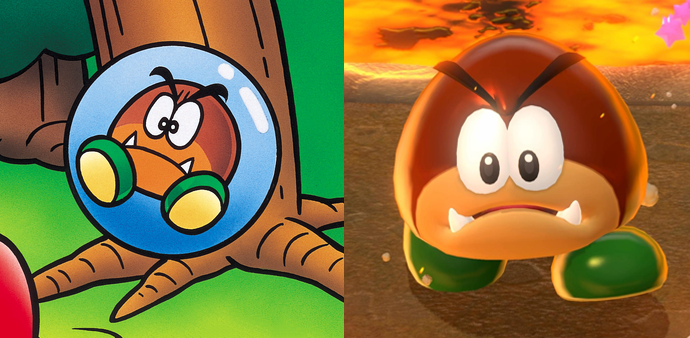
As an American gamer playing Super Mario World in English, I just assumed this was a regional variant of the Mushroom Kingdom Goomba. The Japanese version of the game, however, made it clear that this was something different, and the end credits identify it as クリボン or Kuribon, meaning more or less “chestnut boy.” The distinction just did not exist in the western localization of any game until Super Mario 3D World, which rechristened these rounder, stemless Goombas as Galoombas.
EDIT: After this post went live, I guested on the Tokyo Game Life podcast for an episode about this project. It was pointed out that this discussion of Goombas and produce left out the Goombrat, a variation originating in the New Super Mario Bros. series. It’s clearly based on fuyu persimmon, and this is reflected in its Japanese name, カキボー or Kakibō, with 柿 (kaki) meaning “persimmon.”
33: The Goomba’s western name may not be a reference to Italian culture.
Adaptations like The Super Mario Bros. Super Show! had fun making Mario and Luigi embrace Italian-American culture. They spoke in broad Brooklyn accents and they craved various Italian foods. I think as a result of this association, a lot of us presumed that the Goomba got its name from goombah, which can be an Italian term meaning more or less “pal” but in the U.S. can also be a derogatory term. It might not be that at all, however. In Hungarian, gomba just means “mushroom,” and there are related lookalike words throughout eastern Europe that mean more or less the same thing. In fact, the German term for standard pizza-topper mushroom that we in the U.S. call the cremini is just Bella Gomba, and it’s entirely possible that this is how the Super Mario enemy got its western name, with the similarity to anything from Italy or Italian-American culture being a coincidence.
I discuss the etymology of goomba in greater length in this post.
34: The “P” on the P-Wing comes from an original Super Mario Bros. enemy.
While the Koopa Troopa technically debuted in Mario Bros., Super Mario Bros. introduces its flying form, known in the west as Koopa Paratroopa. In Japan, it’s パタパタ or Patapata, that name being for onomatopoeia for the noise of flapping wings. They’ve been mainstays of the series ever since, but they’re also part of the power-up set featured in Super Mario Bros. 3 in a way that’s not obvious outside Japan. The Japanese name for the P-Wing is パタパタの羽 or Patapata no Hane, which could literally mean “flapping wing” or “fluttering wing,” which wouldn’t exactly be inaccurate in this context, but in this instance probably means “wing of the Patapata” because it allows Mario to fly continuously just like the Koopa Paratroopa can.
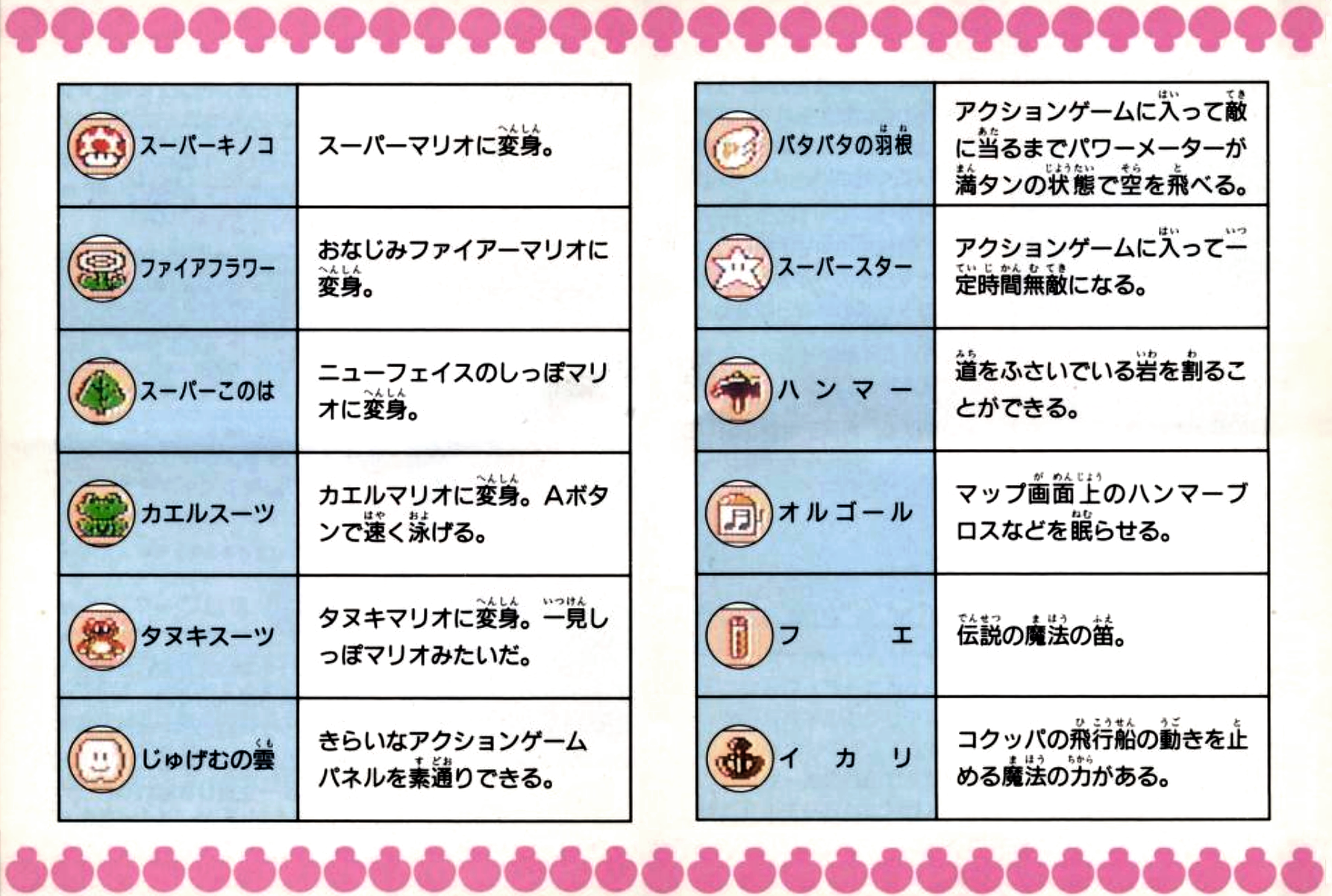
The Japanese manual for Super Mario Bros. 3 only describes the P-Wing as filling up your meter to capacity, allowing you to fly until you hit an enemy. It doesn’t say anything about this item being torn off the back of a hapless Para Troopa.
It’s odd that this was not made clear in the English localization of Super Mario Bros. 3 because it happens that the Japanese and English names for this enemy begin with the same letter, and they wouldn’t have needed to alter the sprite at all. It also fits in neatly with all the other Super Mario Bros. 3 items that allow Mario to borrow the powers of enemy characters — Kuribo’s Shoe, Jugem’s Cloud, the Hammer Brother Suit among them. I have written more about that in this post.
You may have noticed widespread usage of the letter “P” in the design of various Super Mario series elements, including but not limited to P-Switches, P-Balloons, Super Mario Bros. 3 P-Meter and more. In the case of the the P-Meter, which you need to fill up in order to make Mario fly under normal conditions, apparently doesn’t have any connection with the name of the P-Wing, which fills up that meter. That’s kind of confusing.
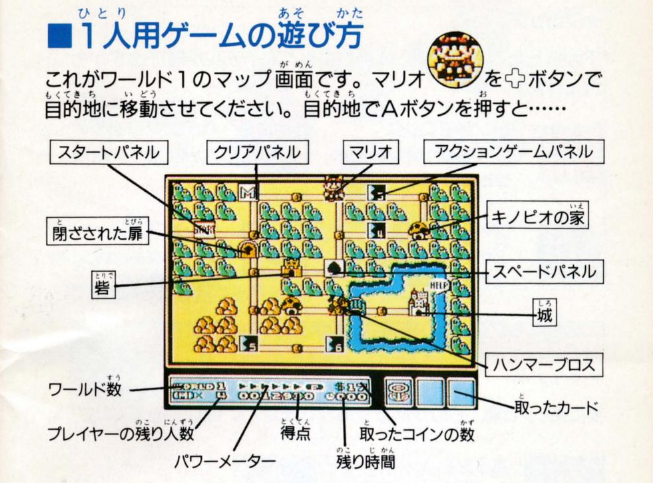
At the bottom of the screen, you can see that the P-Meter is labeled as パワーメーター or Pawā Mētā. It’s referred to as the Power Meter in the English version.
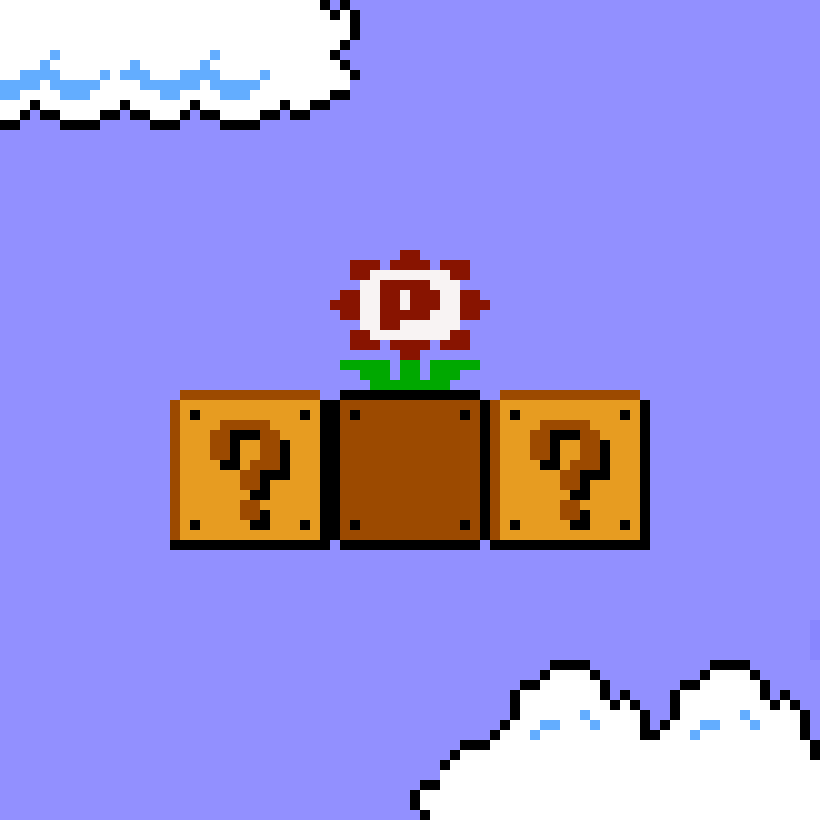
So no, this one letter can stand for a few different things — and sometimes for nothing in particular. In fact, we don’t know what the “P” is supposed to represent in an early development sketch of what would become the Fire Flower.
35: The Paratroopa also birthed a prefix used throughout the Super Mario series.
In the way that Koopa Troopa is an excellent pun, the flying counterpart is also a fairly decent play on the term paratrooper, a portmanteau describing troopers who parachute into enemy territory. They’re not exactly flying versions of regular soldiers, but they are attacking aerially, and I’d imagine that this pun was too good to pass up, even if these enemies have wings instead of parachutes. Subsequent games presented winged versions of other enemies, including the Paragoomba, the Parabeetle, and the Para-Biddybud. Essentially, the para- prefix has taken on a new meaning in the context of the English version of this one video game universe.
What’s especially odd is that the prefix still gets used in the more accurate, real world way as well. Super Mario World introduces Goombas and Bob-Ombs that float down onto Mario using parachutes and they’re called… Paragoombas and Parabombs. Which is confusing.
36: The Piranha Plant has a connection to the first video game superstar.
In Japan, the Piranha Plant is the パックンフラワー or Pakkun Furawā, “Pakkun Flower.” Based on the fact that its basic attack is biting, it shouldn’t seem surprising that its Japanese name shares some linguistic DNA with Pac-Man.

According to Chris Kohler’s 2005 book Power Up, Pac-Man’s name comes from the Japanese expression ぱくぱく食べる, or paku-paku taberu, meaning “to eat heartily,” ぱくぱく or paku-paku on its own being onomatopoeia for the opening and closing of a mouth. The Super Mario Wiki page states that the origin of the Pakkun Flower’s name comes from the the Japanese expression ぱっくんちょ or pakkunucho, which can mean “eating in one bite.” (According to this dictionary, it can also mean “sexual intercourse,” but I’m guessing that is not the intended meaning.) Written in katakana (パックンチョ), it’s also the name of a chocolate treat that debuted in Japan in 1983, shortly before the release of Super Mario Bros. I can’t find any evidence for pakkuncho being the source, necessarily, but if it’s not this then it’s some other word using the paku root and denoting biting, because it like Pac-Man is basically just a living mouth.
37. And Buzzy Beetle shares an etymological link with an iconic Mega Man enemy.
Buzzy Beetle isn’t necessarily an insect. That name came with the English localization of Super Mario Bros. and never left, but more recent art of this enemy character shows that it looks a lot more like a Koopa Troopa — because it is, basically, just one with an extra tough shell.

However, the idea that this enemy is a variant of the Koopa Troopa and not an insect goes back to the beginning. In the Super Mario Bros. fortieth anniversary special published by the Japanese magazine Casa Brutus in 2025, it’s confirmed that Buzzy Beetle’s design evolved from a need to visually communicate to players that this enemy is a variant of the common turtle enemy that couldn’t be killed with fireballs.
From Koopa Troopa — defeated by stomping or fireballs — variants emerged: the flying Para Troopa and the fireproof Buzzy Beetle. Spiny, with spikes on its shell, was created from the idea of “a turtle you can’t stomp.” Each enemy, again, was born from a clearly defined gameplay gameplay role.
In Japan, Buzzy’s name is メット or Metto, a play off the english word helmet, which means it actually has the exact same name as the similarly projectile-deflecting Met enemy in the Mega Man series.
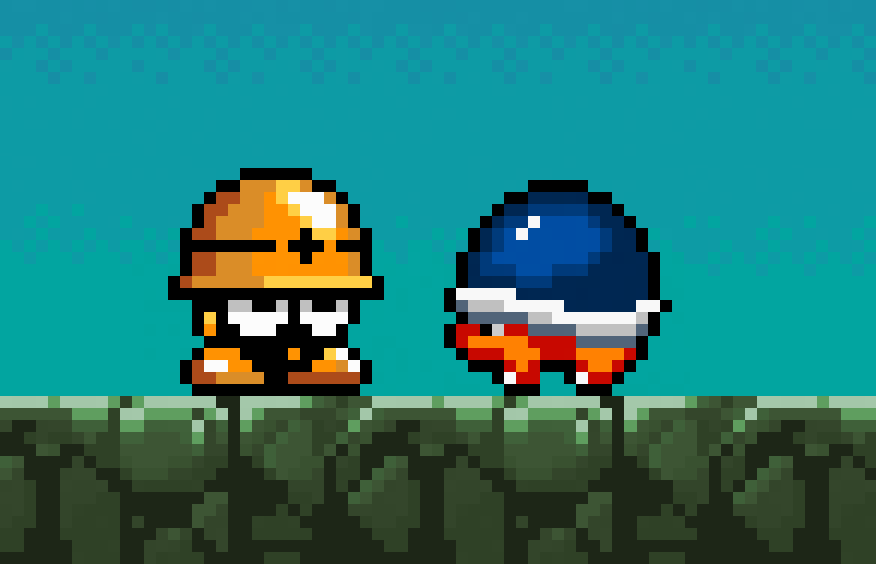
In that series, the Japanese name has been localized a few different ways, including Metall and Mettaur, to the point that it’s not immediately clear what the name is supposed to mean. But yeah, like Buzzy Beetle, it is basically just a walking helmet.
38: There’s a reason so many enemies have repeated syllables in their Japanese names.
Because the Koopa Troopa is known in Japan as Nokonoko, you might assume that the flying variety was named Patapata — two syllables repeated, ABAB-style — to preserve that connection. According to Miyamoto in that 2022 interview with Nintendo Dream magazine, however, it and the many other enemies mentioned in this section were named in honor of and imitation of the aforementioned Takashi Tezuka, who worked as graphic designer and assistant director on Super Mario Bros. as well as on many subsequent games. Says Miyamoto, “[A] lot of names that repeat, like Nokonoko and Batabata, because Tezuka calls himself ‘Tenten.’ It’s kind of childish, but that’s what makes it funny. Thus, we made the ‘repetition series’ of names.”
39: Nintendo may have lost track of which fish enemy was supposed to be called Cheep-Cheep.
What’s not especially complicated is that the Super Mario fish enemy is part of the “repetition series” that Miyamoto mentions in the previous item. The Japanese name, プクプク or Pukupuku, would seem to be inspired by the term ぷくぷく, which can represent the sound of bubbles or the state of being “cute and fat,” both of which make sense for this particular fish. In the 2022 Nintendo Dream interview, Miyamoto mentions that this enemy was almost a member of the “food series,” with a considered but rejected name being テッチリ or tecchirī, a reference to 鉄ちり or tetchiri, a fugu hotpot dish. In explaining the decision to go with one name over the other in the Nintendo Dream interview, Miyamoto makes it clear that the enemy character was always meant to be a pufferfish.
But it changed to the “repetition series.” Tecchirī would’ve been a good choice. Pukupuku is a pufferfish after all, so since it “pukupukus” and inflates, that works too.
What’s a lot less straightforward about this one enemy character is that Super Mario World introduced a related variant of it in a way that’s not fully reflected in English. While the game still features the goldfish-hued Cheep Cheeps, which swim back and forth in a specific patrol zone, it gives the behavior that displayed in the original Super Mario Bros., swimming across the screen in bobbing schools, to a new enemy, Blurp, which is green which has a unique sprite, complete with diving mask. Its Japanese name, ブクブク or Bukubuku, makes it clear that it’s meant to be a variant of the Cheep Cheep, but that’s not made clear in the English localization. They get mixed up on the Japanese side anyway, however, as official art depicting the Special World course Awesome shows Mario being beset by flying Blurps (the green ones) even though the actual in-game version of that level features Cheep Cheeps (the orange ones).
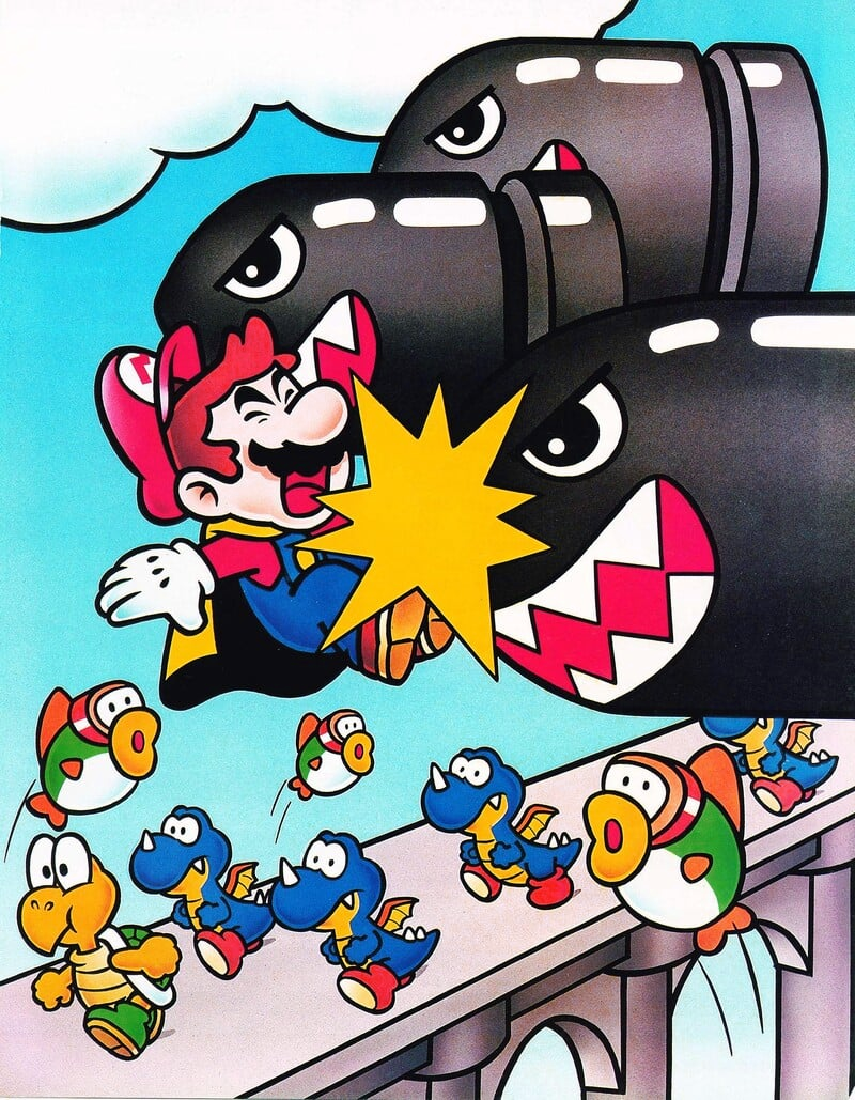
Subsequent games blend the two in weird ways. For example, Super Mario 64 features a goldfish-colored, diving mask-wearing fish enemy, Bub, who’d be restyled in Super Mario 64 DS to better resemble a Super Mario Bros.-style Cheep Cheep. But it also features a big-mouthed variation that can swallow Mario whole, called Bubba or Cheep Chomp, depending on what version of the game you’re playing, and バクバク or Bakubaku in the original Japanese. And the Super Mario Maker series features red and green Cheep Cheeps both, with the green ones behaving like Super Mario World’s Blurps and the red ones patrolling a given zone.
Is it sloppy? Yes. But is it also indicative of Nintendo not fussing over the Super Mario canon or letting any kind of continuity set in previous games dictate what can be done in a sequel? Also yes.
40: And Super Mario Bros. 3 makes two fish enemies out of one.
For no reason I can identify, the English version of the original Super Mario Bros. instruction manual says the Cheep Cheep is female. It’s the only enemy in the whole game that gets this distinction.
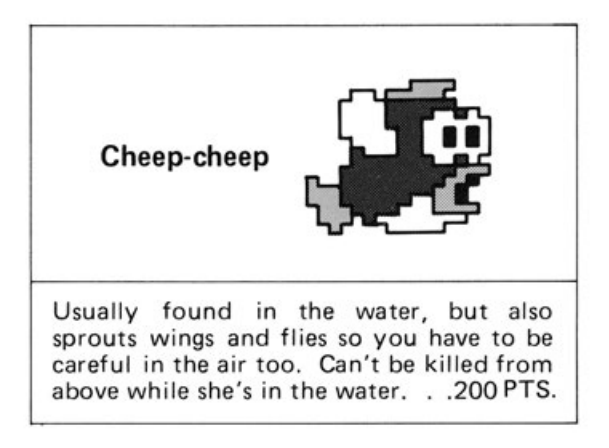
This has been more or less ignored in every subsequent game except for Super Mario Bros. 3, the English version of which makes two weird decisions regarding a supersized version of the Cheep Cheep enemy. For one thing, the game genders this enemy according to its behavior, essentially turning what was one enemy in the Japanese version into two.
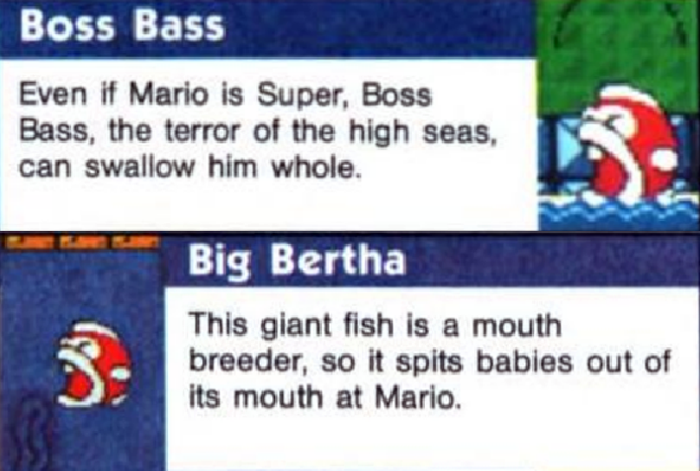
When it’s the version that tries to leap out of the water and swallow Mario whole, it’s Boss Bass. But when it’s the underwater version that opens its mouth and lets a baby Cheep Cheep swim out, it’s Big Bertha. In the Japanese version of the game, they’re both referred to as 巨大プクプク or Kyodai Pukupuku, “Giant Cheep Cheep.” It’s not gendered one way or another, and it also makes it explicit that they’re just meant to be big versions of the regular fish enemy, which the English name doesn’t make clear.
A surprising result of this localization change is that the 1993 live-action Super Mario Bros. movie features a character named Big Bertha. Played by Francesca Roberts, she’s humanoid, but because she wears the bright red associated with the Super Mario Bros. 3 enemy, it seems probable that she’s meant to be a representation of that fish.
Had someone not decided to gender these two fish characters for the western version of the game and essentially create a female enemy character, Big Bertha would presumably not exist in the movie.
41: Blooper’s Japanese name came as a result of Bowser’s.
In that 2002 Nintendo Dream interview I’ve referenced so much, Miyamoto explains that the squid enemy Blooper belongs in the “food” category of monsters because of Bowser. In the interview, he explains his confusion about various Korean dishes, although it’s notable that in this context he doesn’t mention yukke or binbinba and instead brings a new dish into the mix: kalbi, a barbecued rib dish (usually beef) that is rendered in Korean as 갈비 or galbi (literally “rib”) and in Japanese as カルビ or karubi.
Yes, back then, I didn’t have a firm grasp on the difference between kalbi and koopa. But we already put Koopa into the “food series” of names. I mean, Gessō was decided because of Koopa.”
Blooper’s Japanese name, ゲッソー or Gessō, is a play on ゲソ or geso, “squid tentacles.” As far as the English name, I suppose the verb to bloop could mean just about anything, but it seems a perfectly fine word for describing this thing’s movement through water, so it’s one localization I don’t feel confused about.
In the Casa Brutus special issue, it’s noted that a squid enemy was chosen because developers wanted an obstacle whose movement contrasted with that of the Cheep Cheep, which moves in a straight line.
Blooper swims up and down through underwater courses. The idea came from the need for different enemy behaviors underwater — some that move straight, others that drift. “If it’s something that floats, a squid makes sense,” Miyamoto says. “We decided the function first; the outer design comes afterward.”
42: And then there’s Lakitu.
One day I will present to you the actual origin of Lakitu’s name, with testimony from the Nintendo of America staffer who came up with it. This is not that day, because despite my efforts to find a verifiable etymology, I still don’t know who is responsible. But what I expect is that the presumed origin is accurate: that Lakitu’s name comes from a kind of syllable anagram of the name of Tukwila, the Seattle exurb where Nintendo of America was headquartered. Yes, there is an extra letter. No, I don’t have a better guess and neither does anyone else.
I agree with Legends of Localization, however, that this one name has a foreign-seeming ring to it in a way that might make you guess that it was the one Super Mario Bros. enemy name not localized. The Japanese name is, in fact, different. It’s ジュゲム or Jugemu and it comes from a character in a type of minimalist Japanese storytelling tradition called rakugo. This particular story is about a boy who is given a comically long name. (You can read the full name here.) Here’s how Miyamoto explained the thought process on this one in that Nintendo Dream interview.
Jugemu is a character that was drawn by [Takashi Tezuka]. In the world of Super Mario, they’re the most scholarly-looking character (laughs). We decided on this name when we wanted something different from the “food series” and the “repetition series” of names… so we decided to go with the longest name. When it comes to the longest names, nothing tops “Jugemu Jugemu.”
I don’t understand the connection between this particular story and this particular character, I should say. I suppose there is a scholarliness to memorizing a long text, especially one that functions as a tongue-twister. But at least to my western sensibilities, telling comedic stories doesn’t seem like a thing associated with scholars. Maybe I went to the wrong college? Translated from Japanese, 寿限無 寿限無 or Jugemu Jugemu, literally means “long life” or “limitless life,” and that doesn’t seem especially fitting for Lakitu other than the fact that he persists on the screen longer than most enemies in Super Mario Bros. do.
Whatever the thinking, the “Jugemu Jugemu” connection extends to many things associated with Lakitu. The spiked eggs he throws, for example, are known in Japan as パイポ or Paipo because that’s part of the child’s long name. (It’s specifically a fictional kingdom.) And while the Spinies that hatch from these eggs have no connection to the name — they’reトゲゾー or Togezō, likely from 刺 or toge, “spike” — other games have Lakitu throwing spiked balls or Piranha Plant pods. In Japanese, the spiked balls are シューリンガン or Shūringan (the king of that fictional kingdom) and the pods are called グーリンダイ or Gūrindai (the queen of that fictional kingdom). In Paper Mario introduces a pair of teenaged lover Lakitus that are called Lakilester and Lakilulu in English but in Japanese are ポコピー or Pokopī and ポコナ or Pokona, after the prince and princess of the fictional kingdom.
43: Bullet Bill has a small artillery “family.”
Over the years since the release of Super Mario Bros., most of the original enemies have gone on to get their own cluster of bad guys inspired by them. For example, the Hammer Bros. would eventually get the Fire Bros., the Boomerang Bros., the Sledge Bros., and the Sumo Bros., among others. One enemy that has gotten that only in a small way is Bullet Bill. I don’t know if Bullet Bill is even an actual enemy so much as ammunition that Bowser’s troops fire at Mario, but here is his moment regardless.
Known in Japan as キラー or Kirā, literally “Killer,” Bullet Bill’s design was inspired by “shark mouth”-style nose art painted on fighter jets, per that 2002 Nintendo Dream interview. The first and most famous variant of Bullet Bill to appear in a later game was the supersized version in Super Mario World. While the Japanese name was マグナムキラー or Magunamu Kirā (“Magnum Bullet Bill,” essentially), the localized English name went with Banzai Bill. Nintendo stuck with that localization until 2020, with the release of the Super Mario-themed LEGO set Boomer Bill Barrage. Ever since, Nintendo has referred to the big Bullet Bill by this new name. Although Nintendo has never issued a statement on why, it’s presumed that the Japanese exclamation 万歳 or banzai being associated with kamikaze pilots during World War II.
People localizing later Mario games have occasionally taken the opportunity to name similar names in the style of his English name — but by my count only three times. Super Mario World features an underwater model named Torpedo Ted (in Japanese just トーピード or Tōpīdo). Super Mario Galaxy features a stationary explosive enemy named Mikey Mine, whose Japanese name, キライラ or Kiraira, might be a portmanteau of 機雷 or kirai, “mine” but also Bullet Bill’s Japanese name, indicating that the presumed “relation” may be intentional. And then Super Mario Bros. Wonder introduces Missile Meg, effectively giving a more individual identity to what is known in Japan as ロングキラー or Rongu Kirā, essentially just “Long Bullet Bill.”
And that’s it. How lonely the Bullet Bill family reunion must be, but also perhaps that is for the best, considering that they are just explosive artillery.
44: The castle level firebars were originally designed for Legend of Zelda.
In the Iwata Asks promoting New Super Mario Bros., it was revealed that Super Mario Bros. was made more or less concurrently with Legend of Zelda, with the same team working on both. As a result, some ideas passed from one title to another, and one of these were the spinning firebars that ultimately ended up plaguing Mario in castle levels.
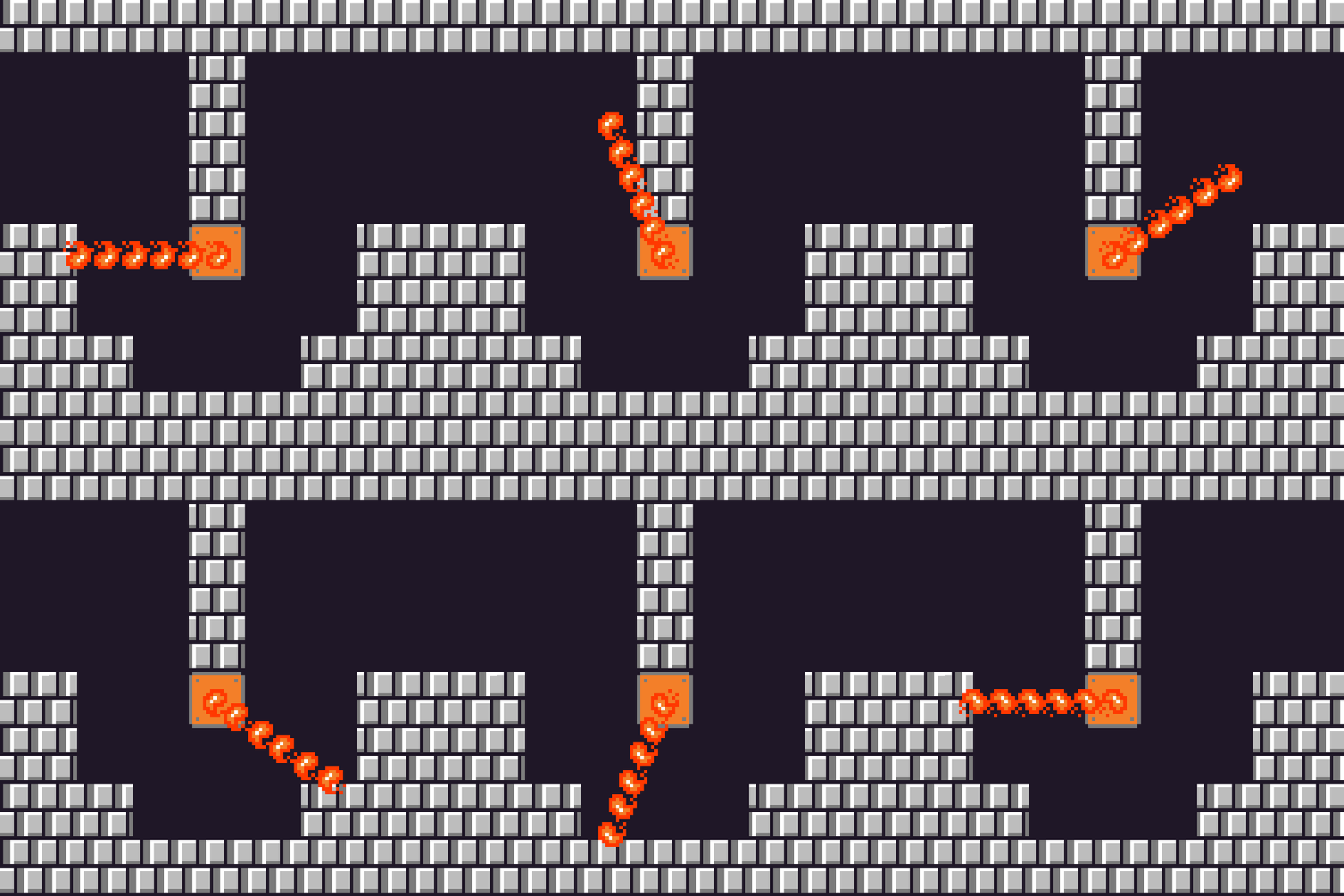
They were initially conceived as an obstacle in Legend of Zelda dungeons, however,
Toshihiko Nakago (programmer): Occasionally you'd get a transfer of ideas from one game to the other. For instance, there are bars of fire in Super Mario, aren't there?
Satoru Iwata: You mean the spinning bars of fire attached to the castle walls that you encounter as you make your way along the corridor to fight Bowser?
Nakago: Right. Those first appeared right in the centre of the screen in Zelda.
Iwata: …Really!?
Nakago: Yes, that idea originally comes from Zelda. We thought it would work better in Mario, so we transferred it across. I think it was Miyamoto-san who suggested it. Or perhaps it was
Takashi Tezuka: It must have been Miyamoto-san.
Nakago: I wonder…
Iwata: There's a fair chance that you may have simply forgotten about it, Tezuka-san! (laughs)
These objects would appear first in a Zelda game in A Link to the Past and since have become recurring fixtures in the series.
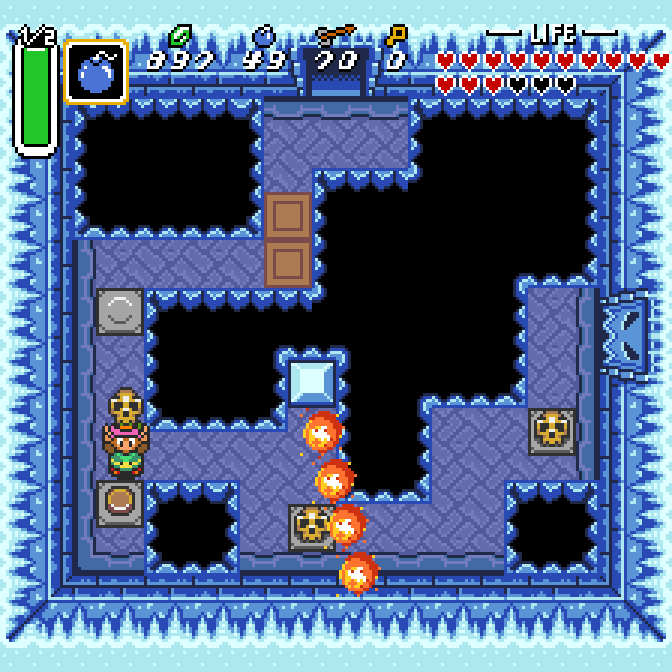
It’s also not the only element initially conceived for a Zelda game that debuted in a Super Mario game first, and I detail that in no. 68.
45: Mario won’t bring down Bowser’s bridge unless he has to.
I can’t defend it at all, but it was only while compiling this list that I understood why there’s an axe to the right of the bridge on which you fight Bowser in every castle level of Super Mario Bros. Tagging the axe makes the bridge fall and sends Bowser into the lava, and although there’s no animation to make it clear, the implication is that Mario uses the axe to cut the support chains holding the structure up. I just never really noticed the handful of pixels stretching diagonally on the right, suggesting those chains.
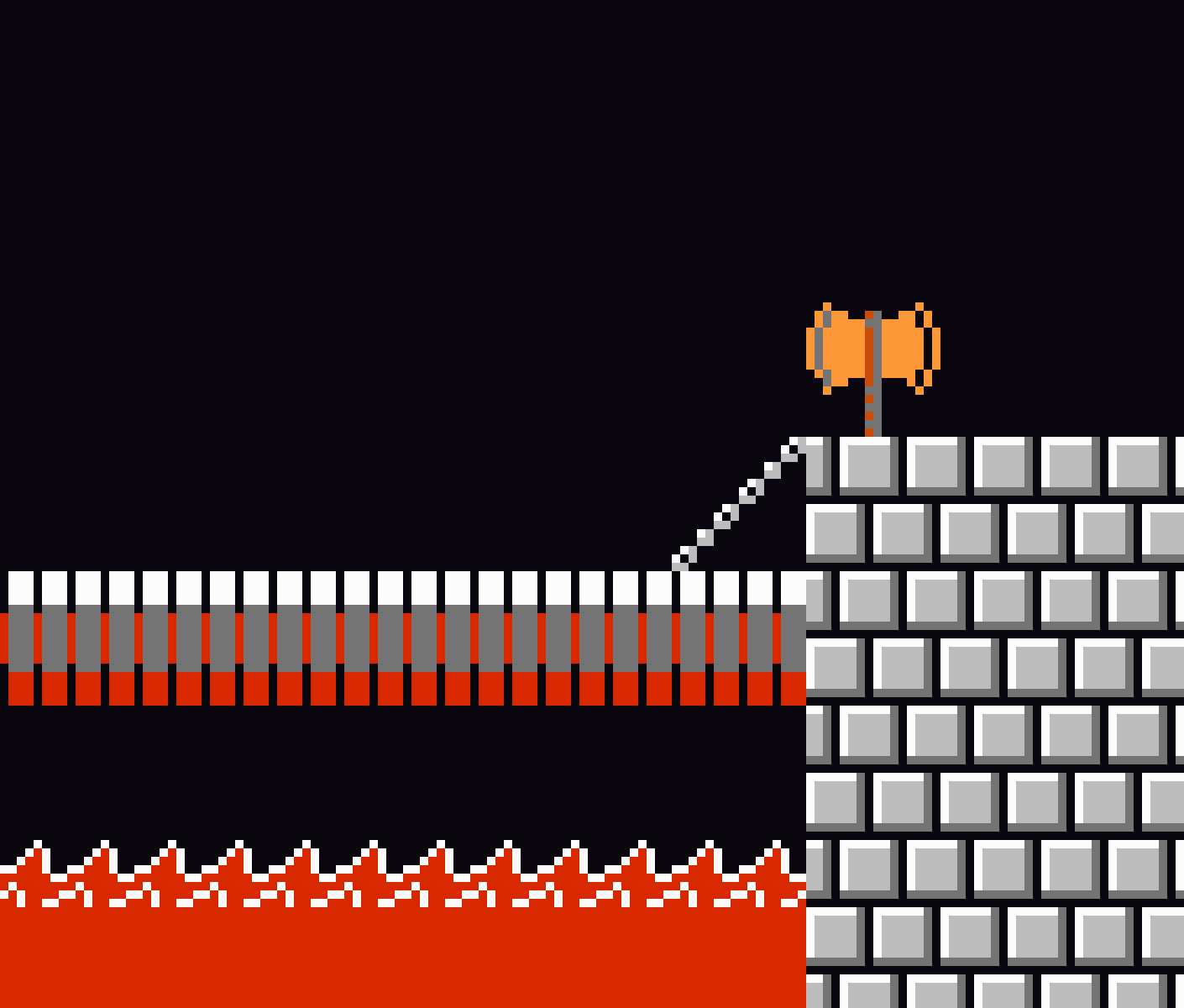
One of the things that makes this clearer is that if Mario uses fireballs to kill Bowser, he’ll pass by the axe without collapsing the bridge — because he doesn’t have to, because Bowser is already dead.
I honestly feel like this is one of those things that most everyone else already put together, but it was in 2026 when I finally had this explained to me. Thanks, Chris Kohler — for this and for many things! I… still think Bowser should just grab the axe and use it against Mario, but whatever.
At the risk of sounding more dense that I need to, I should probably point out that I wrote this item before I saw The Super Mario Galaxy Movie, which does show Mario cutting the supports to the bridge.
For what it’s worth, however, the scene also reinterprets the axes. Bowser brings them to battle with the intent of using them on Mario and Peach. I assume this was done on the part of the movie’s writers or designers to answer logical questions the viewer might have, regardless of whether they get the reference. For one, why would Bowser be keeping a cutting implement so close to the supports that hold up the bridge? And for another, if the axe is right there, why wouldn’t Bowser use it?
But I’d also like to think that there was at least one other long-timer who didn’t put two and two together with the axe until seeing this part of the movie — you know, for the sake of me being less dense.
Navigation:
Part One (1-15): Mario and Luigi origins / Donkey Kong and Mario Bros.
Part Two (16-30): Bowser, Peach and Toad / Super Mario Bros.
Part Three (31-45): The enemies of Super Mario Bros.
Part Four (46-60): Super Mario Bros. miscellany / Super Mario Bros. 2
Part Five: (61-75): Super Mario Bros. 3 and Super Mario World
Part Six (76-90): Yoshi and Donkey Kong (and friends)
Part Seven (91-101): Various beloved supporting characters and also Stanley the Bugman
Part Eight: A sort of junk drawer including Peach’s dad, Bowser’s wife and the infamous field horsehair plants
Part Eight (102–116): A sort of junk drawer including Peach’s dad, Bowser’s wife and the infamous field horsehair plants