


46: The Mushroom Kingdom has a complicated relationship with Alice in Wonderland.
In a 2005 interview with Business Week, Miyamoto seemed to say that Alice in Wonderland figured into the genesis of Super Mario Bros.
It started with a simple idea. I thought: “I wonder what it would be like to have a character that bounces around. And the background should be a clear, blue sky.” I took that idea to a programmer, and we started working on it. Mario ended up being too big, so we shrank him. Then we thought, “What if he can grow and shrink? How would he do that? It would have to be a magic mushroom! Where would a mushroom grow? In a forest.” We thought of giving Mario a girlfriend, and then we started talking about Alice in Wonderland.
To be fair, it’s not clear exactly how Alice in Wonderland figures in, as it’s just thrown in at the end of the quote. But given how both the book and the 1951 animated Disney film have the title character eating from either side of a mushroom cap in order to make herself grow or shrink, the implication would seem to be that this inspired the way Super Mario Bros. mushrooms make Mario grow bigger.
However, one year later, during an Iwata Asks interview, Miyamoto returns to that statement and says he was misinterpreted.
Well, the mushroom… When you think about Wonderland, you think about mushrooms, right? … Some time ago I was being interviewed and I spoke about Alice in Wonderland. But it seems there was some misunderstanding, and it’s since been stated that I was influenced by Alice in Wonderland. That isn’t the case. It’s just that there has always somehow been a relationship between mushrooms and magical realms. That’s why I decided that Mario would need a mushroom to become Super Mario.
In a 2010 interview with Evan Narcisse for Time magazine, Miyamoto is given the opportunity to address the connection but deflects.
Narcisse: One of the things I’ve read is that the magic mushrooms in the Super Mario games come from myths about enchanted food. Is that true?
Miyamoto: Whether or not this is actually a factor or not, we’re not really sure. But this whole idea of mysterious foods that have mysterious properties comes from a lot of the European folktales. Of course, you see foods like that in Alice in Wonderland. I’m not really sure if the Japanese folk really knew what we were referencing. But that was sort of kind of where it was coming from. At least I think that’s what it came from.
And then five years later, speaking to NPR, he brings it up again, hinting that yes, there is a connection but stopping shy of making it explicit.
In the original Mario Bros., Mario and Luigi were rather small in size and they would play and battle against each other in that game. And in the Super Mario Bros. game, those same small characters are in the game, but when they get a mushroom they get big. So we decided to call the big versions of them Super Mario and Super Luigi because they got super-sized. … [O]f course, getting an item and growing big is sort of a mysterious thing to have happen. And so we thought, what's the most mysterious item that we could make so it makes sense why they’re getting bigger? And if you think of stories like Alice in Wonderland and other types of fairy tales, mushrooms always seem to have a mysterious power, and so we thought the mushroom would be a good symbol for why they get it and get big.
It’s an odd collection of statements. On one hand, there’s not another cultural work that I know of that so famously connects mushrooms with a character changing their size. In fact, I’m not sure there’s another instance in the whole of culture aside from the Super Mario games, so it would be a huge coincidence if Miyamoto and Lewis Carroll both arrived at the idea on their own. On the other hand, if Alice in Wonderland did inspire the Super Mario games, I can’t imagine a reason Miyamoto would want to hide that, especially because Nintendo creatives have readily admitted to a great many works inspiring their games.
Unless…
47. No, the Super Mario mushrooms are probably not inspired by real-life psychedelic ones.
That one weird kid in elementary school who told you that the Super Mario games were actually about DRUGS was not well-informed, it turns out. This is another popular urban legend that was helped into existence by the fact that the original English instruction manual for Super Mario Bros. did in fact refer to the item that makes Mario grow big as Magic Mushrooms. And yes, that term was in use back then to refer to psilocybin mushrooms. Seems fairly un-Nintendo, no?

FWIW, the original Japanese version of this page refers to them as mushrooms and Super Mushrooms both, but not by any drug slang.
Subsequent games would call them Super Mushrooms (because they turn him into Super Mario, after all), but Nintendo would also eventually decide that the caps should be red with white spots. And that happens to make them look a lot like the cap of the Amanita muscaria, a different mushroom that is hallucinogenic but is not psilocybin, instead creating a variety of effects including Alice in Wonderland syndrome, which makes the experiencer perceive objects to be bigger or smaller, closer or farther away than they actually are.
That syndrome might seem like a clincher, but in this piece, which is longer than the more bite-sized items I’m writing for this list, I come down on the side of the Super Mario games alluding more to the history of European mushroom lore and imagery, which re-emerged in kitschy pop culture in the 1970s and 1980s both in the west and Japan. Often, however, these mushrooms were devoid of hallucinogenic associations, instead being symbols of rural life or even Christmas specifically.
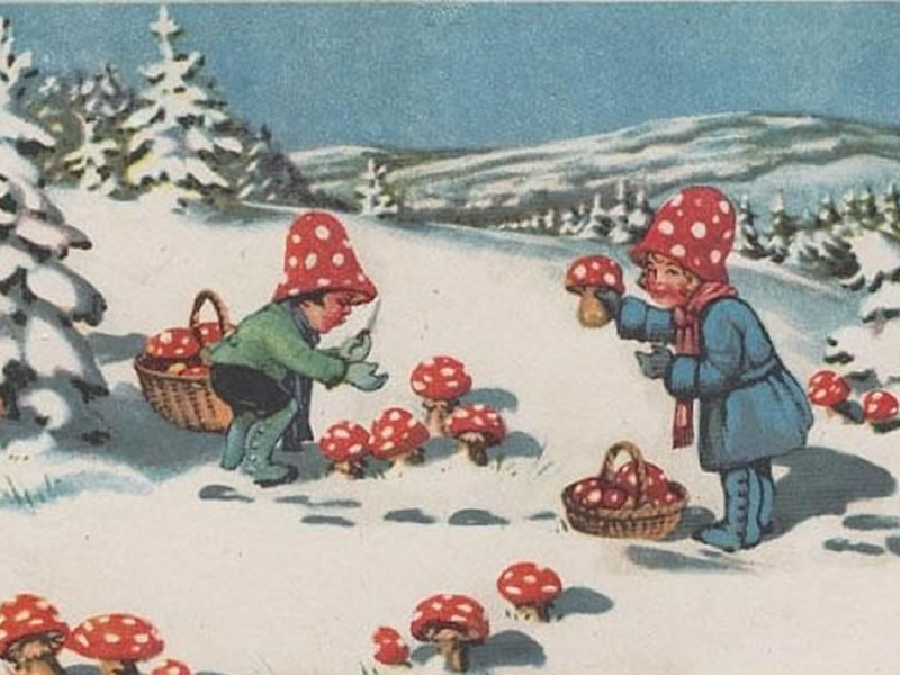
To me, this version of these red-capped, white-spotted mushrooms make a lot more sense appearing up in the pop culture of a country such as Japan, which has strict laws against using narcotics and psychotropics. It’s probably a stretch, but the association between hallucinogenic drugs and Alice in Wonderland might even explain why Miyamoto deems disinclined to discuss any links between the book and the Super Mario series.
48: No, you’re not actually killing Mushroom Kingdom citizens by breaking bricks.
Somehow, we collectively remembered that Bowser transformed Peach’s subjects into “stone, bricks and even field horsehair plants” but forgot the part that clarifies that no, Mario is murdering people when he breaks those bricks.

Just a few pages later, in the same manual, it’s explained that the innocent Toads who have been turned into bricks are the ones who offer Mario rewards when he hits them. Essentially, the bricks are just bricks, but the transformed Mushroom Kingdom residents don’t shatter and instead yield power-ups, coins or 1-up mushrooms.
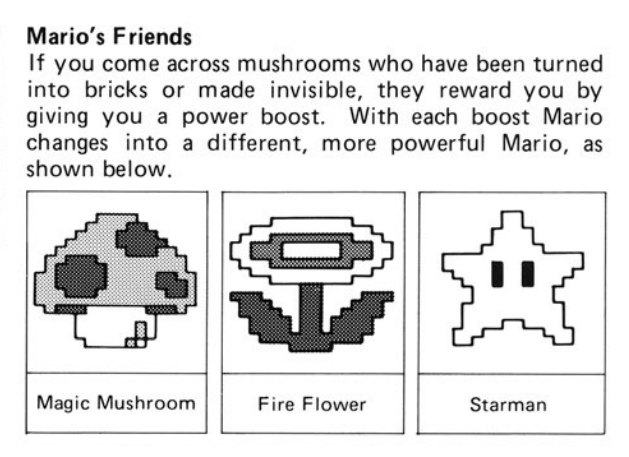
So you’re still striking them, I guess, but no Toads were harmed in the breaking of bricks — canonically and definitively.
49: Super Mario Bros. changed the meaning of the phrase ‘warp zone.’
Prior to the 1960s, the term warp zone was used in a geologic sense, more or less as a synonym for what today might be called an escarpment — a slope or cliff existing between two chunks of land with different elevations. On its own, warp has meant “to bend, twist or distort” going back to the fifteenth century, and it’s that sense that starts to appear in science fiction literature as early as 1936, according to the OED, which cites an issue of Amazing Stories as using the phrase space warp to describe movement by a vehicle using the distortion of time. According to Den of Geek, it’s a 1948 issue of Amazing Stories that first uses the phrase warp drive, and that phrase would later be popularized by the original Star Trek series. But it’s that sense, essentially meaning “to teleport” that shows up in Super Mario Bros., which might have been the first instance of warp zone being used in its modern sense.
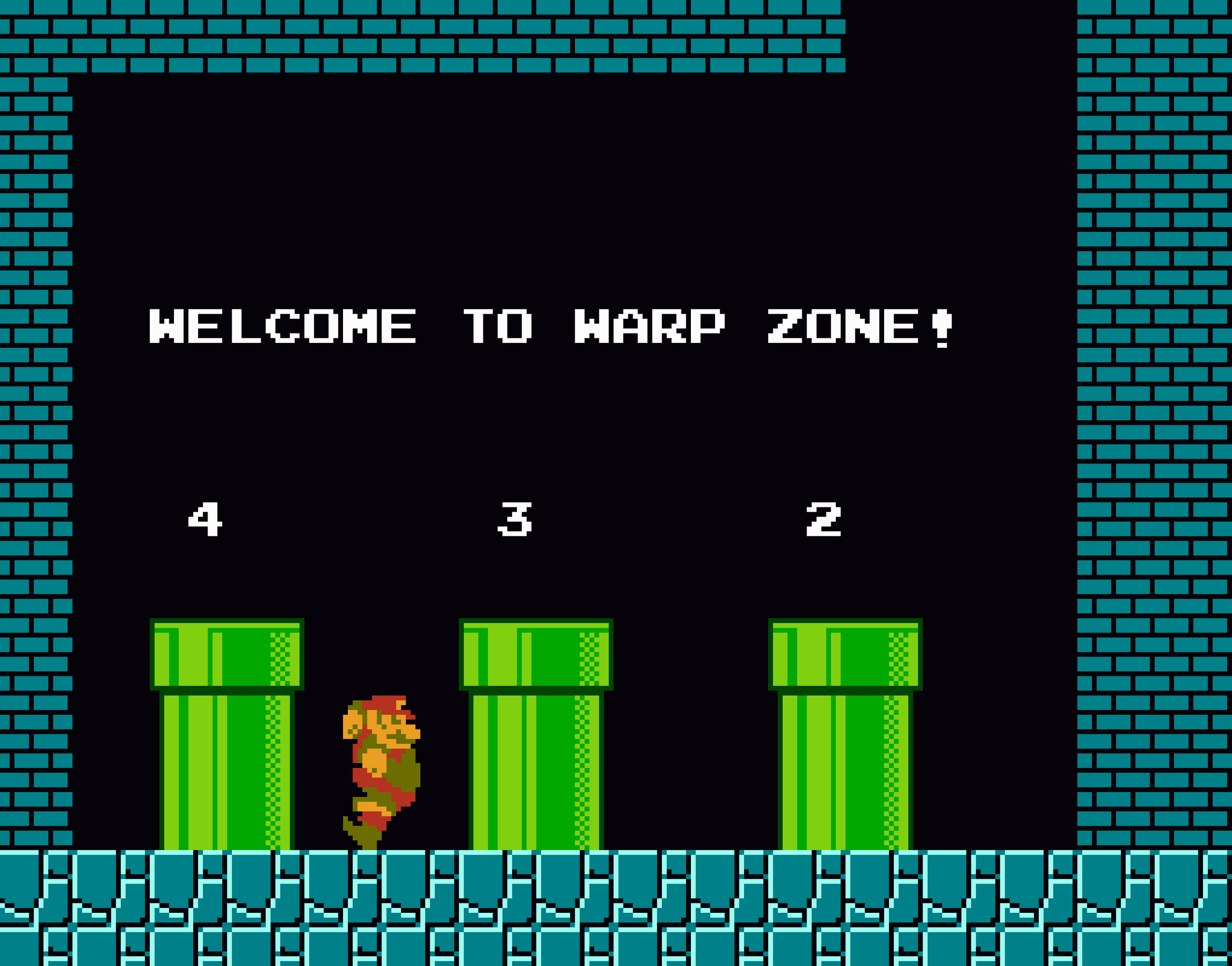
It’s possible some work — a book or a comic or maybe even another video game — used the term warp zone in its modern sense before the release of Super Mario Bros. I couldn’t find it if there was. But given how successful Super Mario Bros. ended up being, it is likely the work that popularized this new sense and ended the phrase’s previous association with geology. At the very least, the cover story of the April 3, 1989, issue of Newsweek uses the phrase in a way that has nothing to do with Nintendo; in a story about the opening of MGM Studios at Disney World, Charles Leerhsen writes as follows.
But no one in America has a neater job than Michael Eisner. Besides making the movies he wants for Walt Disney Studios and its sometimes more mature subdivision, Touchstone PIctures, he gets to pass judgment on the latest designs for Mickey Mouse watches and lord it over the company’s theme parks. These include Disneyland, the southern California original, and Disney World — which may have started out to be the East Coast version of the above, but has become, over its 17-year-history, something much more; a kind of warp zone of warmth and family values, similar to the Thanksgiving-dinner table, where people congregate to assure themselves that the world’s a fine place after all.
It has been suggested that warp zone may have originated as wasei-ego, a type of Japanese expression constructed by combining English words in a new way. This would seem to be how we got other video game terminology such as power-up, level-up and 1-up, but I was not able to find an instance of ワープゾーン or Wāpu Zōn that predates Super Mario Bros.
50: Contrary to popular belief, Doki Doki Panic actually began as a Super Mario game.
The popular narrative states that Doki Doki Panic, the game that would become the western Super Mario Bros. 2, was essentially an unrelated title that only became part of the series after the fact. That’s mostly true, but according to Jon Irwin’s 2014 book on the subject, Doki Doki Panic grew up out of a prototype for not only a Super Mario-style game but in fact an idea for a sequel to Super Mario Bros.
An early, in utero version of [Doki Doki Panic] began as a follow-up to their most successful yet: They were experimenting with a new Super Mario Bros. game. This one, however, would pay homage to the past, placing the goal not far down a horizontal path, but at the top of the level, just like Donkey Kong. Only this time, the world would extend beyond the top of the screen. Secret areas of Super Mario Bros. existed above the clouds, but were rare and a single level above the main path. This new game would continually ascend, mirroring this company’s confidence after a century of finding its way.
But when Shigeru Miyamoto and a young developer named Kensuke Tanabe looked at this prototype, they felt something was off. Two characters stacked blocks on top of each other to progress ever-upward, but the screen only moved in single jarring swoops, shifting up once you approached the top, so that you’d begin again near the bottom. … “Make something a little bit more Mario-like,” Tanabe recalls his boss telling him. The compromise called for a game including horizontal levels such as [Super Mario Bros.], but smaller sections of this new kind of vertical gameplay. Lifting blocks turned into pulling up vegetables as projectiles. What began as an experiment shifted into an amalgam of past successes with new ideas.
I discuss this in greater detail in a post titled “There’s Super Mario DNA in Doki Doki Panic,” which also notes that Doki Doki Panic is actually the first game to reuse the POW Blocks from Mario Bros.
You can still see vestiges of this tech demo in Super Mario Bros. 2 and Doki Doki Panic.
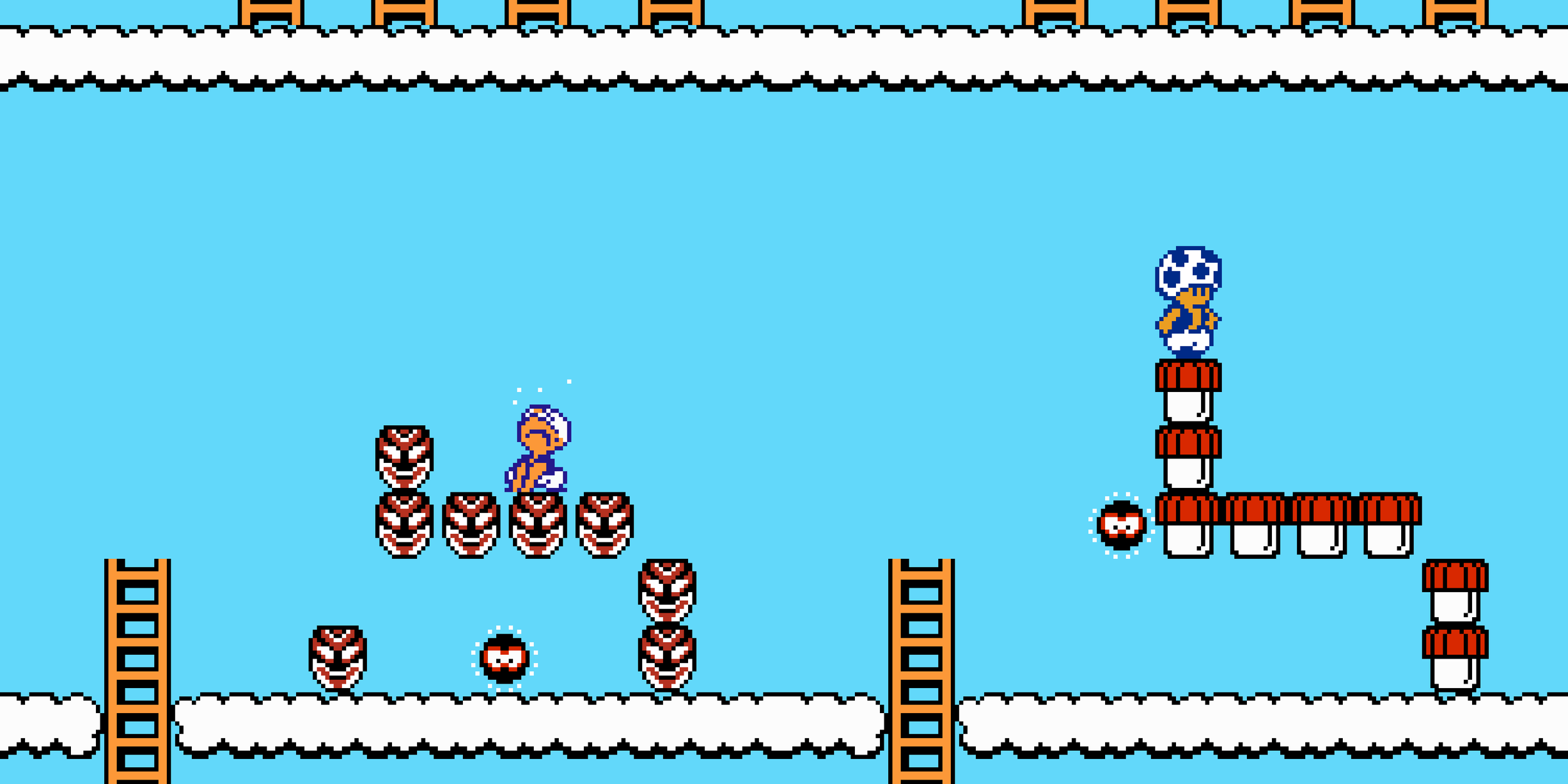
In both, level 7-1 has you stacking blocks to ascend vertically. Because of the mask theme I will discuss in the next item, the “blocks” in Doki Doki Panic are masks, but they’d be switched out for wooden mushroom blocks in Super Mario Bros. 2. Either version is essentially a one-player version of what’s described in this early attempt as a Super Mario Bros. sequel.
51: There’s a very promotional reason Super Mario Bros. 2 abounds with masks.
Even as a kid who loved Super Mario Bros. 2, I remember wondering what was up with all the masks. Not only do many enemies wear them, some just literally *are* masks.
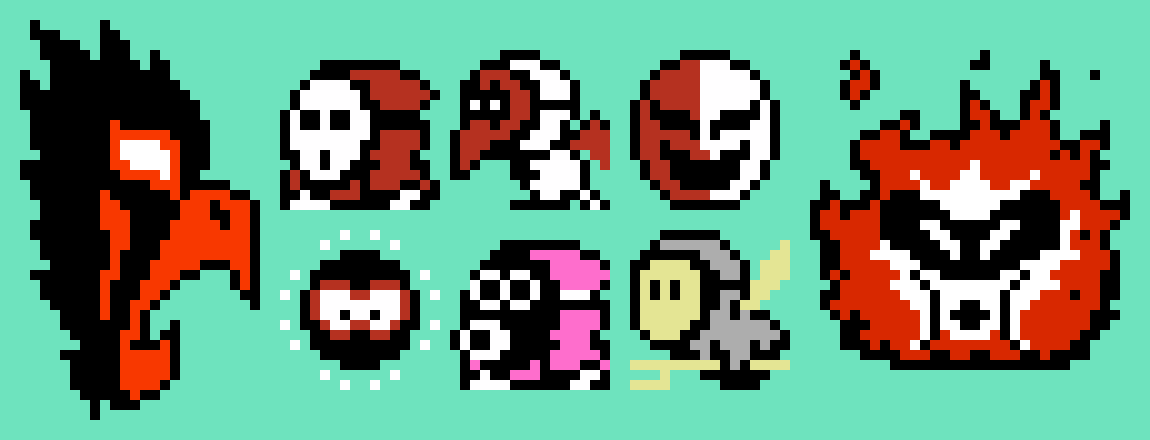
Clockwise from top-right: Hawkmouth (the gate that eats!), Shy Guy, Tweeter, Phanto, Fry Guy, Beezo, Snifi and Spark (which is arguably the least masky of all of these but really what is the difference between disembodied eyes and a living mask?
The answer lies in Doki Doki Panic being a game Nintendo created in support of Communications Carnival Dream Factory ’87 (コミュニケーションカーニバル 夢工場'87), a sort of World’s Fair-like event held in Tokyo and Osaka and sponsored by Fuji TV, a Japanese television station. Partially inspired by Brazil’s Carnival festivals and partially by Disney World’s Epcot Center, Dream Factory ’87 is probably best explained by the below 2022 video from GTV. It’s no coincidence that the model glimpsed in the thumbnail art is holding a mask.
To a degree, the Epcot-ness of the event also explains why the original heroes of Doki Doki Panic seem to be pulled straight from Arabian folklore; the Disney attraction opened in 1982 and Dream Factory ’87 seems to be trying for a similar celebration of international cultures. Even the main hero’s name, Imajin (イマジン), from the Japanese rendering of the word imagine, recalls the Journey Into Imagination, the flagship Epcot ride. Imajin, his parents and his girlfriend Lina amount to west Asian stereotypes, it should be said, but the reason they’ve never appeared in a subsequent Nintendo title is probably the fact that as the event’s mascots, they’re presumably owned by Fuji TV.

No Smash Bros. for you, Imajin.
52: That said, Lina lives on.
In Doki Doki Panic, the four playable characters each have something that makes them special. Papa is the strongest and can lift items quickly, Mama can jump the highest, Lina can hover in midair for a few seconds, and Imajin is the most well-rounded of the group.
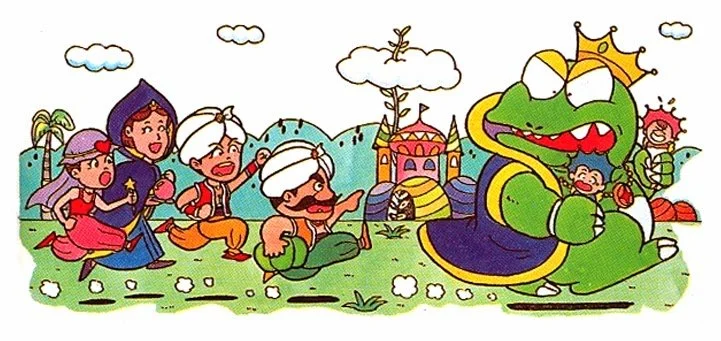
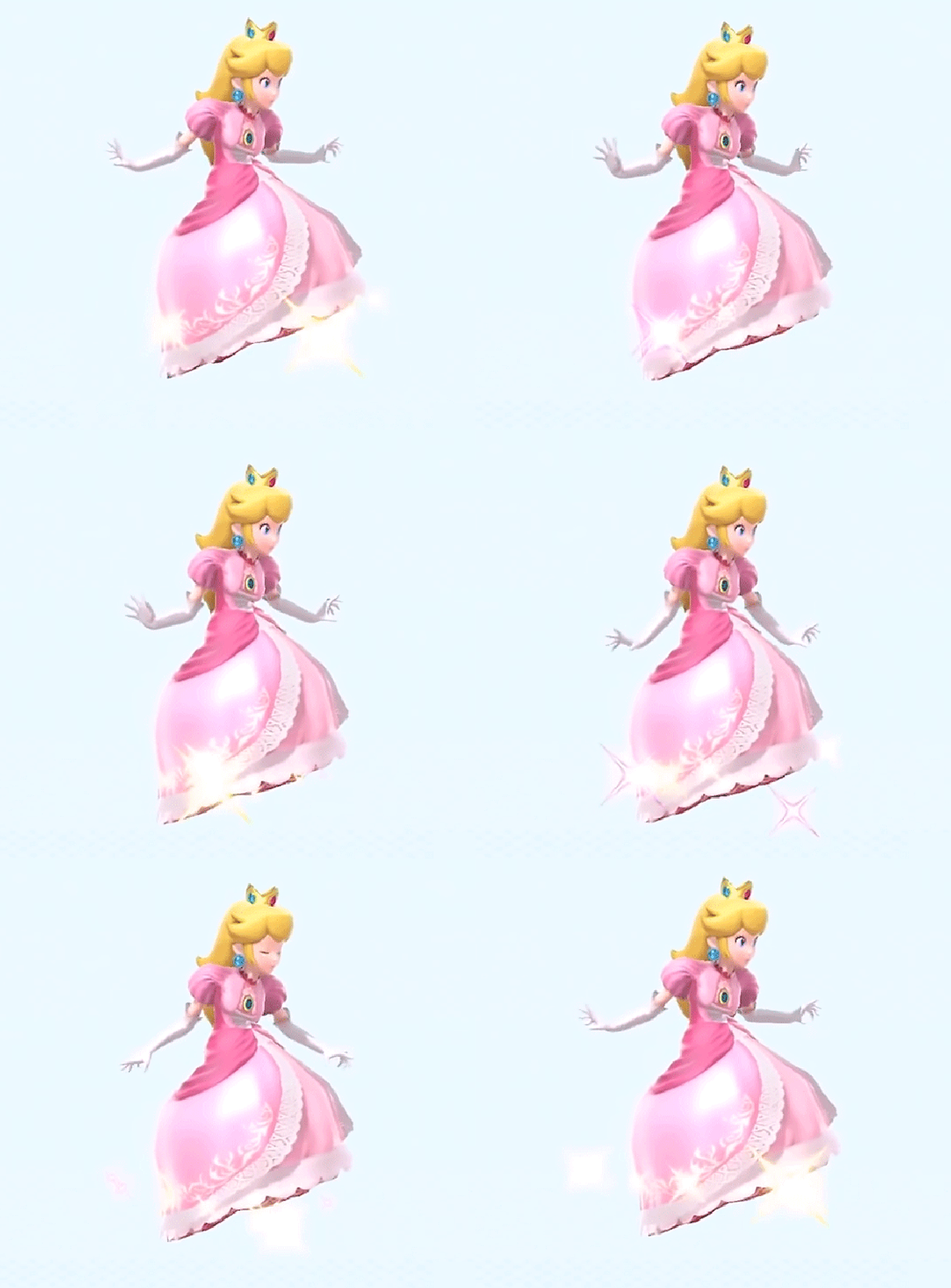
Of all of them, Lina is basically the only one one who’s had much of an afterlife, even if she was also doomed not to reappear in another game. Her unique trait was passed on to Peach in Super Mario Bros. 2, who still gets this signature ability more often than not. For example, Peach has this ability in the Smash Bros. games because Lina had it in Doki Doki Panic.
The same can’t be said for Imajin, Papa and Mama. I guess you could say that Mario inherited his average stats from Imajin, but he probably would have ended up being Mr. All-Around anyway. Luigi technically inherited Mama’s ability to jump the highest, but he actually already had that from The Lost Levels. And while Toad does sometimes display Papa’s ability to lift heavy things with ease, particularly in Wario’s Woods, he’s not given a chance to show this very often.
53: There’s a reason that Super Mario Bros. 2 is missing a level.
Every world in Super Mario Bros. 2 has three levels except for the last, which only has two. This goes unexplained in the game, but the backstory to Doki Doki Panic makes it clear why.
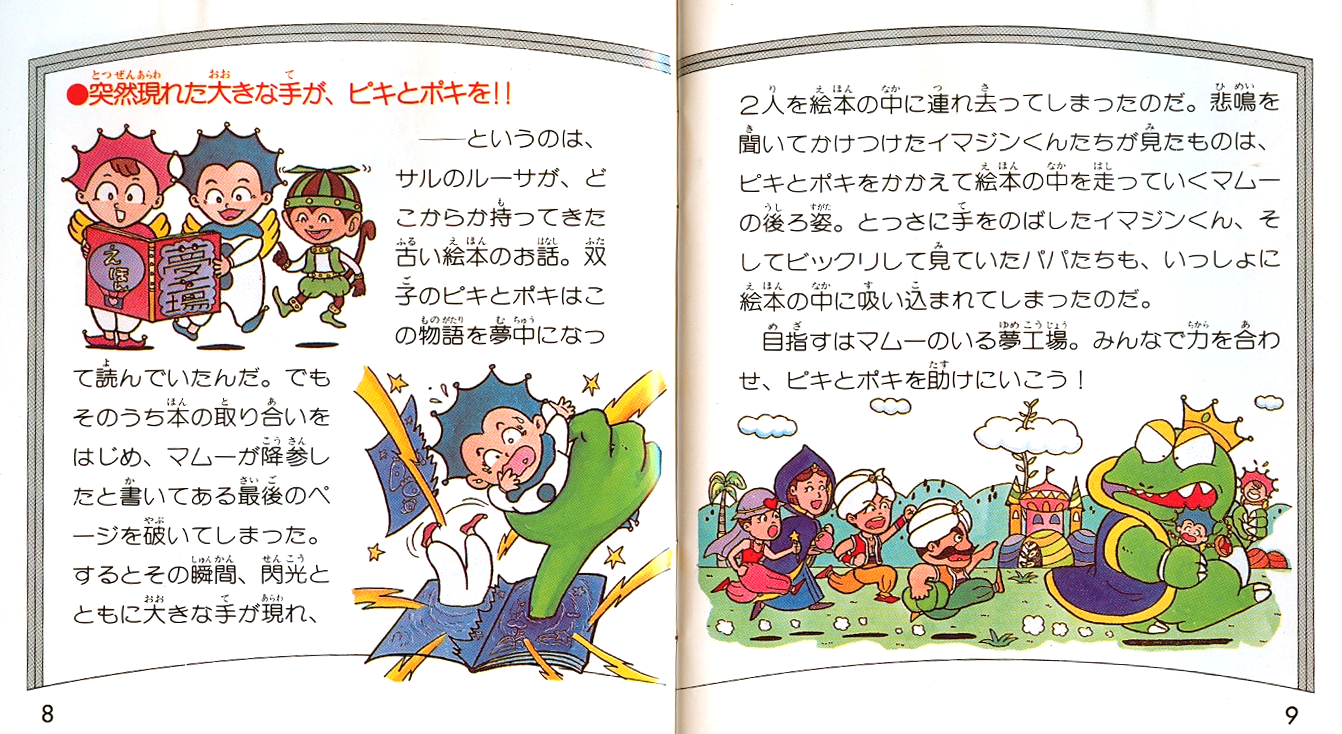
Translation: Piki and Poki and the giant hand that appeared out of nowhere! This is a tale about when Rūsa the monkey brought an old picture book from somewhere. Twins Piki and Poki were absorbed in the story as they read. But eventually, they started fighting over the book and tore up the last page that said Mamū had surrendered. At that moment, in a flash of light, a large hand appeared and took them both away into the storybook! Imajin and his companions hear their screams and see Mamū running through the picture book with Piki and Poki in his arms. Imajin immediately reached out his hand, and he, along with his father and the others who looked on with surprise, are pulled into the book. Your goal: the Dream Factory, where Mamū resides. Work together to save Piki and Poki!
Imajin’s younger brother and sister, Piki and Poki, are fighting over a storybook about Mūkai, the land of dreams, when they accidentally rip out the page that details the defeat of the story’s villain. (It’s who we call Wart in the west, but here is Mamū, which is a play on 夢魔 or muma, “nightmare,” and which is the name he keeps in the Legend of Zelda series.) He then pulls the twins into the story, which is lacking its final chapter as a result of that missing page. Super Mario Bros. 2 ditches this framing narrative in favor of a new one, and this explanation is entirely lost.
I discuss this in greater detail in this post.
54: Technically, Super Mario Bros. 2 was made *after* Super Mario Bros. 3.
The original Super Mario Bros. was released in Japan and North America both in fall 1985. The Japanese sequel, which we in the west call The Lost Levels, followed shortly after in Japan, on June 3, 1986, but was not released internationally. (According to key Nintendo of America employee Howard Phillips, he found The Lost Levels punishingly hard and worried it would drive away the then-growing fanbase for all things Super Mario.) As a result, Doki Doki Panic was turned into the sequel outside Japan, even if it ditched the original’s hopping and bopping for plucking and chucking. Super Mario Bros. 2 debuted in North America on October 9, 1988. Little did most of us know at the time, however, but Japan would get Super Mario Bros. 3 that very month; we wouldn’t get the third game until more than a year later, in February 1990.
A curious result of this timeline, however, is the fact that development on the western SMB2 actually began while work on SMB3 was already underway. As a result, the sprites in SMB2 arguably look better than the ones in the sequel. In fact, by comparing them, you can see how the SMB2 ones are actually based on the ones in SMB3, with extra pixels shifting Mario’s pose from in profile to a three-quarters perspective or making Peach’s hair appear fuller and more like how she was drawn in the instruction manual.
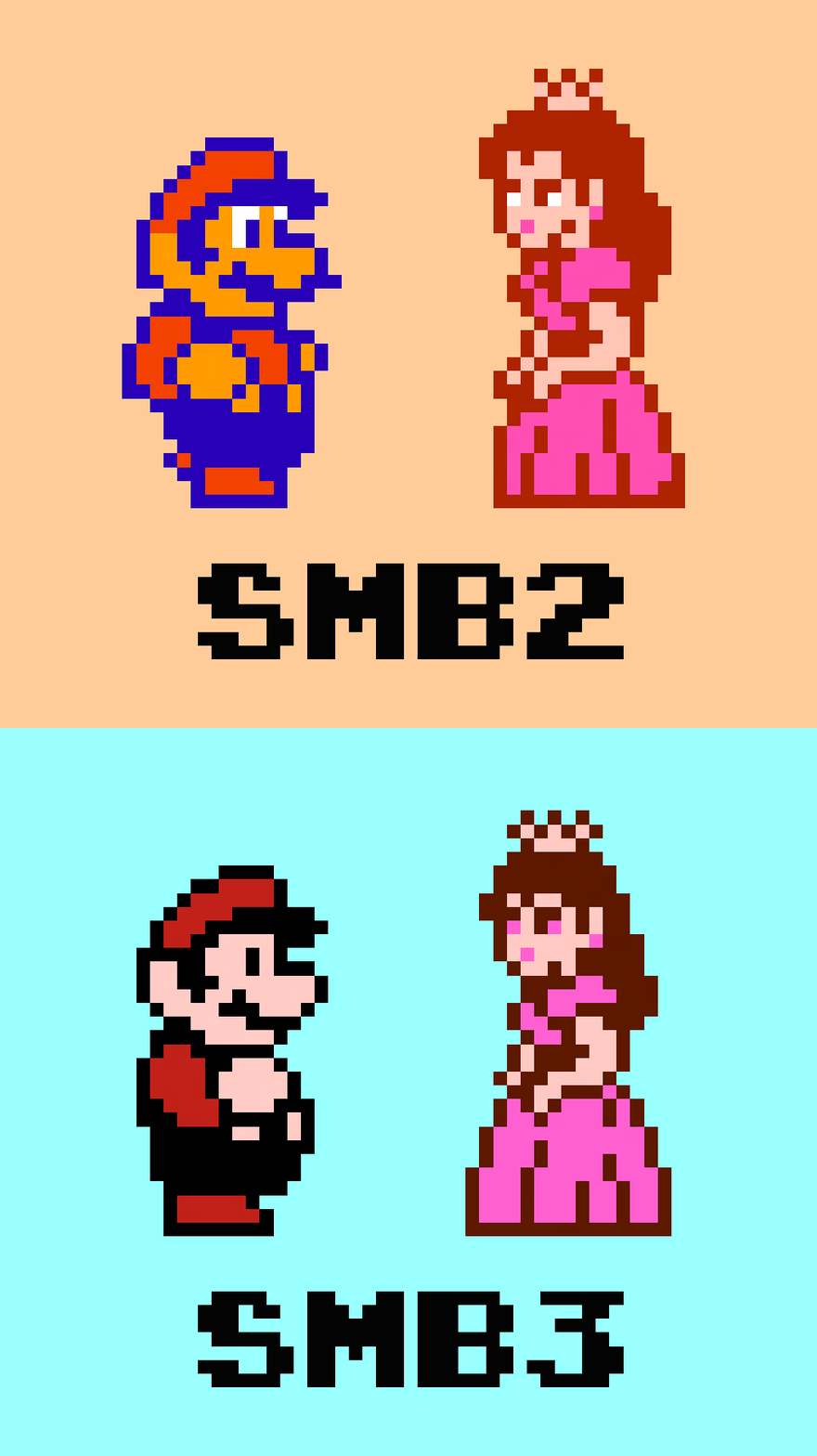
It also meant that Luigi got his own distinctive sprite, showing him to be taller than Mario, in the west before he would in Japan. He’d been a palette swap for Mario in SMB, the Lost Levels and SMB3. It wasn’t until the western Super Mario Bros. 2 was released in Japan — as Super Mario USA, on September 14, 1992 — that gamers there got to see him looking different, though by then they’d already seen him get a unique sprite in Super Mario Kart, which was released there the previous August.
55: Super Mario Bros. 2 gave Toad an individual identity that he didn’t necessarily have in Japan.
The instruction manual for Super Mario Bros. 2 identifies Toad as one of the Mushroom Retainers from the first game but also gives him what at the time seemed like an individual name. The implication is that there are Mushroom Retainers, and this particular one is named Toad.
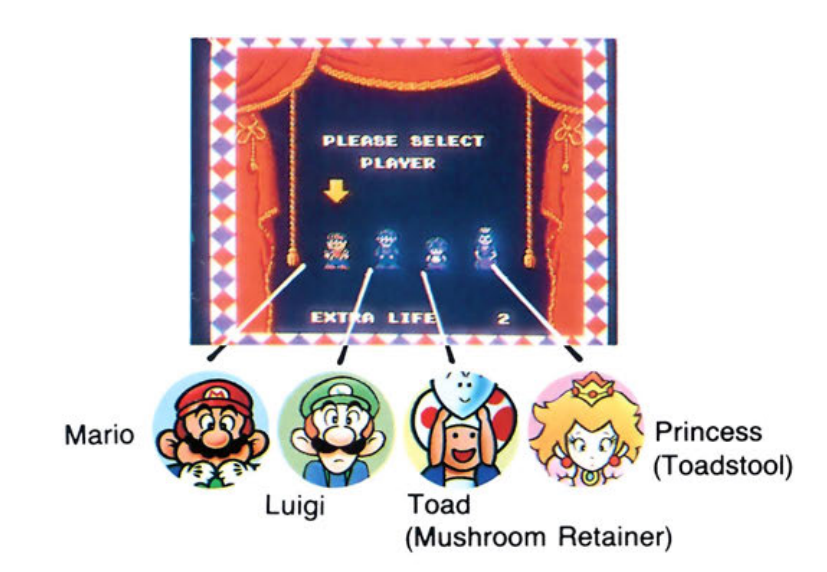
Because Super Mario Bros. 2 released at what turned out to be peak Mario mania in the U.S., Toad was cemented in the minds of western fans as an important member of the core team, alongside Mario, Luigi and the princess. The Super Mario Bros. Super Show!, for example, accurately reflected this, as did virtually any piece of SMB2 merchandise. In Japan, however, the Toad we know did not necessarily exist as a specific, individual character. Toads, in the plural, exist throughout Super Mario Bros. 3, but none of them are necessarily the blue-hued guy from SMB2, which did not exist in the Japanese conception of the series until years later.
To western players, for example, the Toad who is playable in Super Mario Kart seems like he should be the one and the same who was playable in SMB2, but he’s not necessarily any more of a singular character as the Koopa Troopa that is also playable in that game.
Weird, no? I suppose I’d liken it to Pokémon, which offers us both Pikachu as a specific character and the mascot of the series but also at the same time a species of creature that exists in multiples throughout these games.
56: Unique Toads would eventually exist, however.
Super Mario Sunshine introduced Toadsworth, a doddery old man Toad who served as a kind of paternal figure for Peach. And shortly thereafter, Toadette was introduced to the series as Toad’s racing partner for Mario Kart: Double Dash. Their Japanese names reflect that they’re both “specific” twists on the usual Toad formula: Toadsworth is キノじい or Kinojii, meaning “old man mushroom,” essentially, while Toadette is キノピコ or Kinopiko, the -ko suffix denoting a diminutive and feminine form of Toad’s Japanese name, キノピオ or Kinopio. New Super Mario Bros. introduced two more: Yellow Toad and Blue Toad, the latter of whom would appear on his own in Super Mario 3D World, likely as a callback to the blue-hued Toad from Super Mario Bros. 2, even if this latter game just referred to him as Toad.
It’s not as clear-cut whether Captain Toad is meant to be “our” Toad just leveled-up and working with a new title. And then I’m entirely unsure about Chef Toad, a character who at least so far exists only within Super Nintendo World at Universal Studios.
57: The Bob-Omb did not actually debut in Super Mario Bros. 2.
Of everything that Super Mario Bros. 2 has given to the series at large, the most meaningful contribution is probably the Bob-Omb, which has been a big part of almost every subsequent game. However, this enemy may not have actually originated in SMB2, even if a throwaway line in the Japanese Super Mario Bros. 3 manual makes it seem like this is the case.
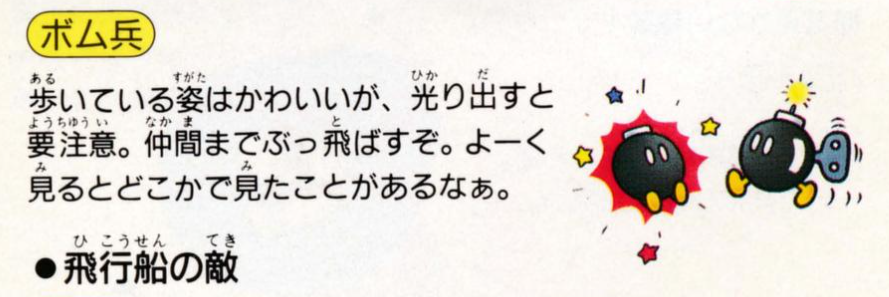
Translation: “Its walking looks cute, but be very careful when it flashes. It even blows away [its] companions. Take a good look and you might notice you've seen it somewhere.”
That second sentence makes it seem like SMB3 is acknowledging that this enemy came from SMB2, but if you remember the timeline I mentioned in item no. 54, that can’t be. Instead, I think the place the manual says you might have seen this walking bomb before is actually Doki Doki Panic — which means the Bob-Omb went from that game to SMB3, totally bypassing SMB2 because this would have been programmed before anyone at Nintendo had any inkling that Doki Doki Panic would be folded into the Super Mario series.
What’s more, the manual of Doki Doki Panic identifies this guy as ボブ or Bobu, “Bob.”
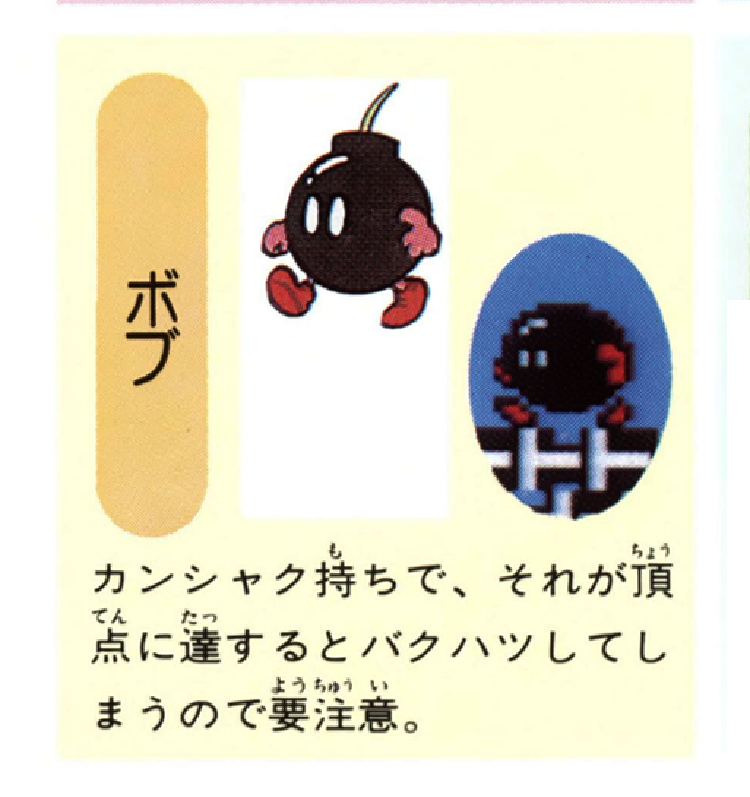
Also note that weird floor texture, which doesn’t appear anywhere in the game. The same screenshot was reused for the SMB2 manual.
The Japanese SMB3 manual, meanwhile, calls them ボム兵 or Bomuhei — something like “Bomb Soldier” or “Bomb Trooper,” but not the same name as the character had in Doki Doki Panic. And if we’re getting super pedantic about it, and I obviously am, it is notable that the Doki Doki Panic version is given arms, which no subsequent version of the character has had.
Whatever actually happened, it’s clear that someone working on Super Mario Bros. 3 thought the series could benefit from having some version of the little bomb guys who walk around and then flash before going kaboom. The Doki Doki Panic version got redesigned and then renamed, and it’s been a part of the series ever since. But it’s only outside Japan that the old version and the new version are named the same thing.
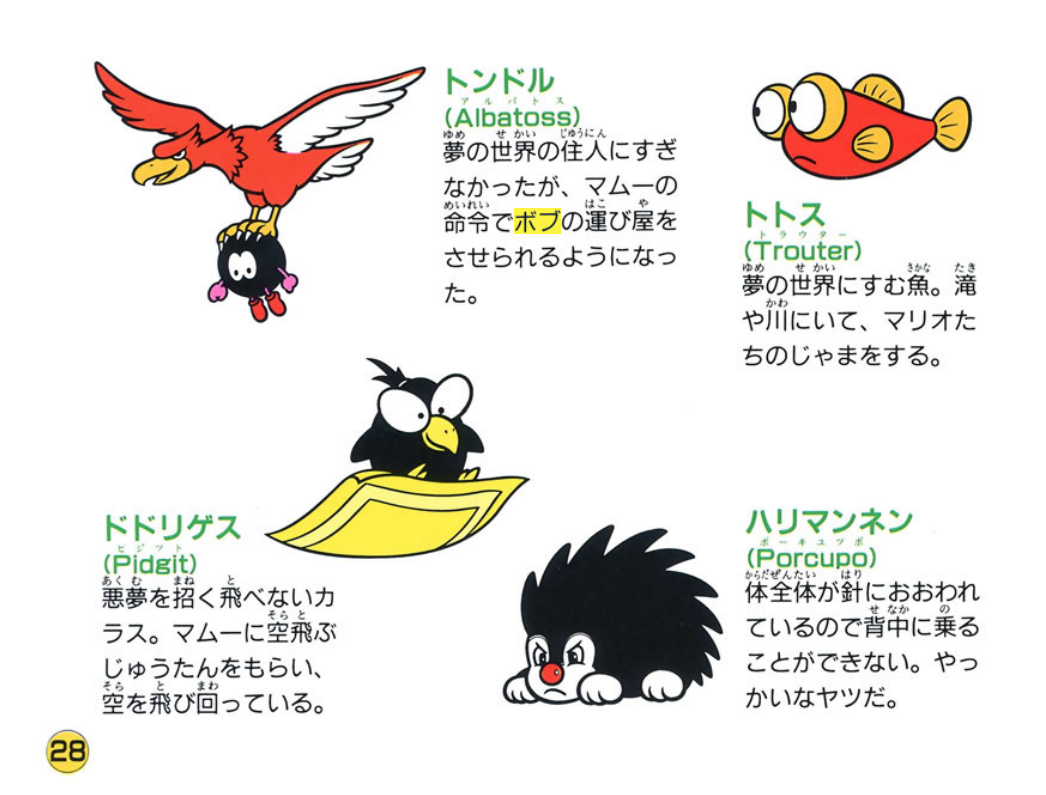
Maybe the most telling sign of the fact that they’re not, in fact, one and the same is that the manual for Super Mario USA doesn’t treat them that way. For most of the enemies, they’re given their original, Japanese names first. This page, for example, leads with the Shy Guy’s Japanese name, ヘイホー or Heihō, and then after that puts the katakana rendering of its western name, シャイガイ or Shaigai.
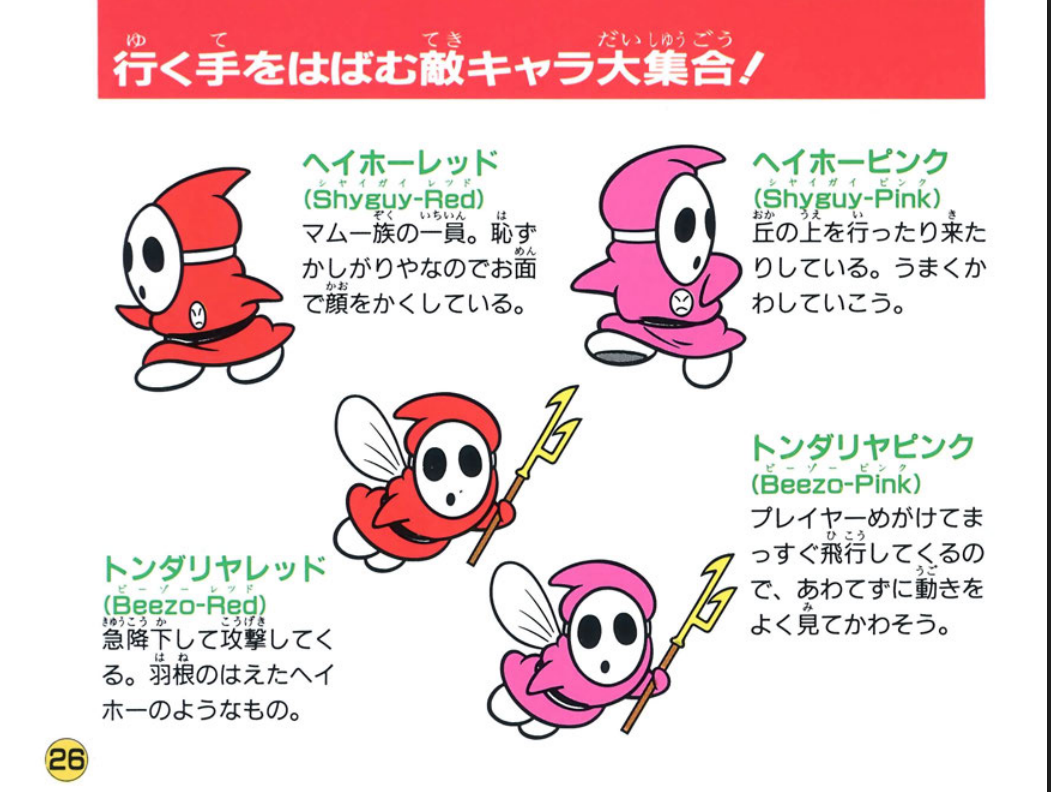
The bomb enemy doesn’t get its own entry for some reason, but when it’s referenced in the entry for Albatoss, it’s only referred to as ボブ or Bobu and not as ボム兵 or Bomuhei.
What’s more, the Perfect Edition of the Great Mario Character Encyclopedia lists the two separately, if directly next to each other.
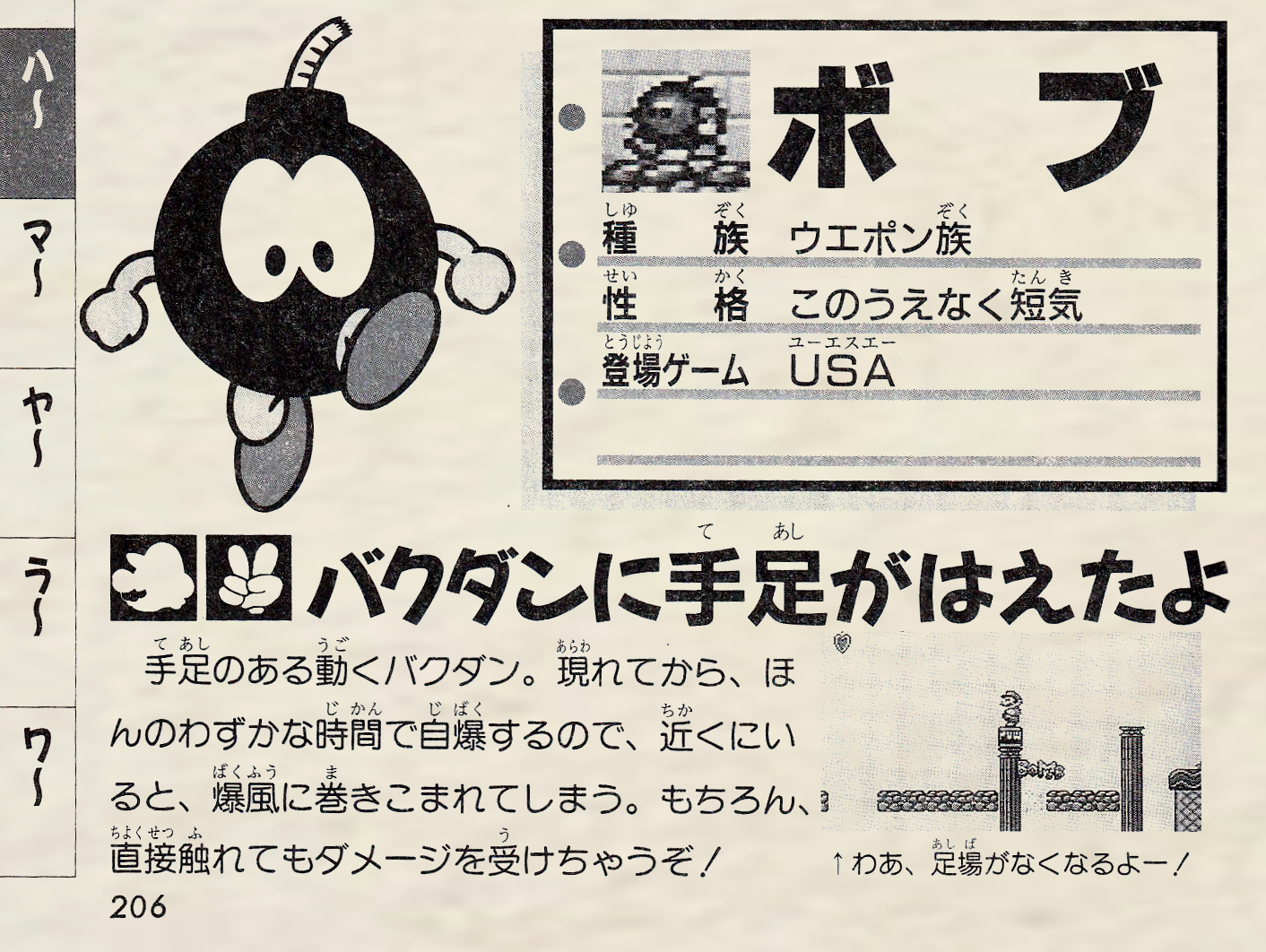
Translation: Bobu or Bob
Tribe: Weapon Clan
Personality: Has an insanely short fuse
First game appearance: Super Mario USA USA
A bomb that grew arms and legs. / A bomb with arms and legs. It’ll self-destruct soon after appearing, so be careful not to get too close and be caught in its blast. Touching it directly is sure to hurt you!
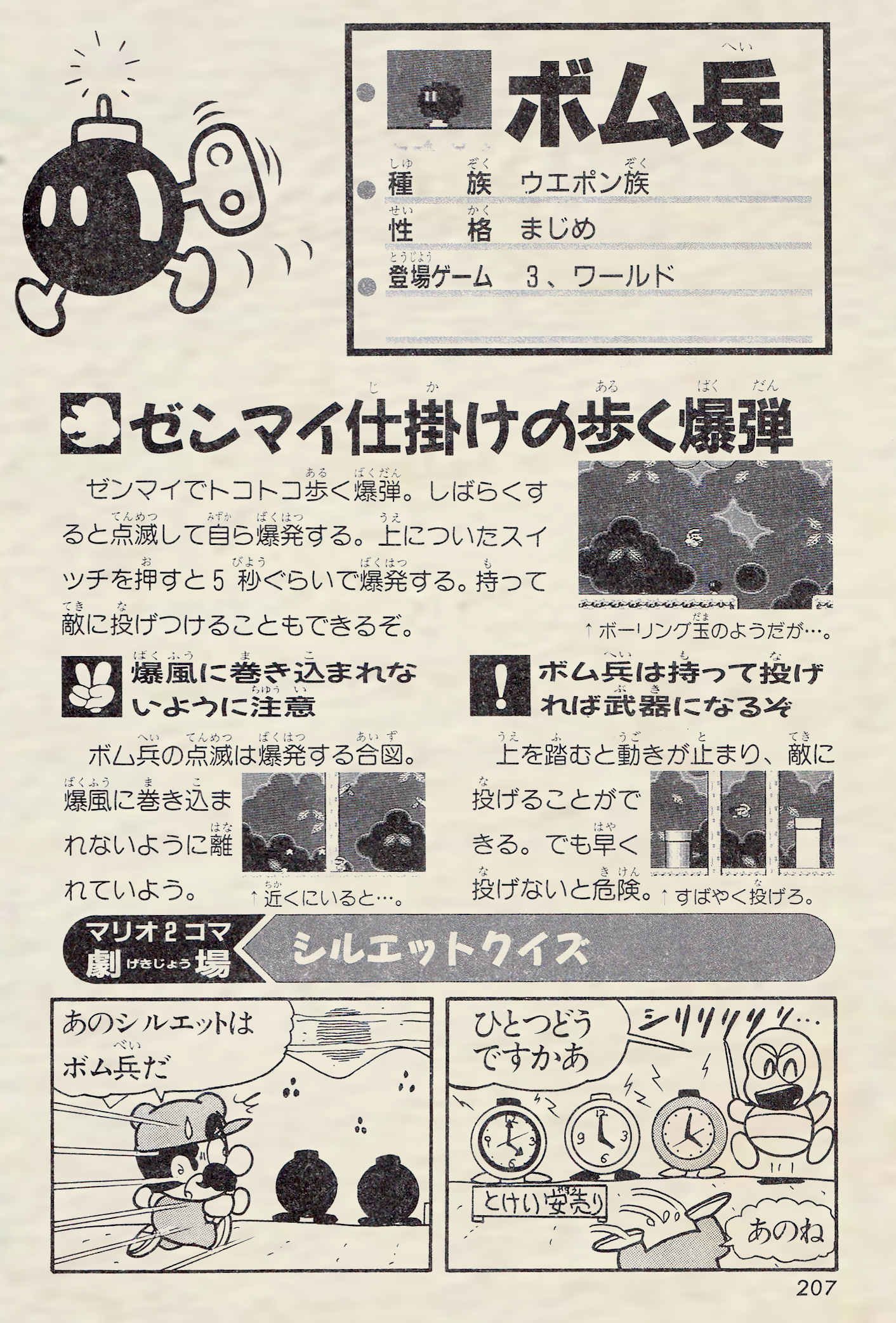
Translation: Bob-omb
Tribe: Weapon Clan
Personality: Serious
First game appearance: Super Mario Bros. 3, World
A wind-up walking bomb. / A wind-up waddling bomb. Will self-destruct shortly after flashing. Pressing the switch on the top will cause it to explode in about five seconds. You can also pick it up and throw it at an enemy.
Be careful not to get caught in its blast. / When Bob-omb flashes, that's a sign that it's about to explode. Make sure to keep your distance to not get hurt by its blast.
Pick up and throw Bob-omb to use it as a weapon for yourself. / Step on top of it to make it stop, then pick it up and throw. But make sure to be quick about it.
58: Meaning that the first Super Mario Bros. 2 enemy to appear in a later game is actually Pokey.
The shambling cactus monster is known in Japan as サンボ or Sanbo, from サボテン or saboten, “cactus,” in both its debut appearance, Doki Doki Panic, and in its first series appearance, Super Mario World. While most of their Super Mario appearance gives them the yellow, spiky-headed look in Super Mario World, Pokey still occasionally sports the green, flat-headed look it initially had in Super Mario Bros. 2.
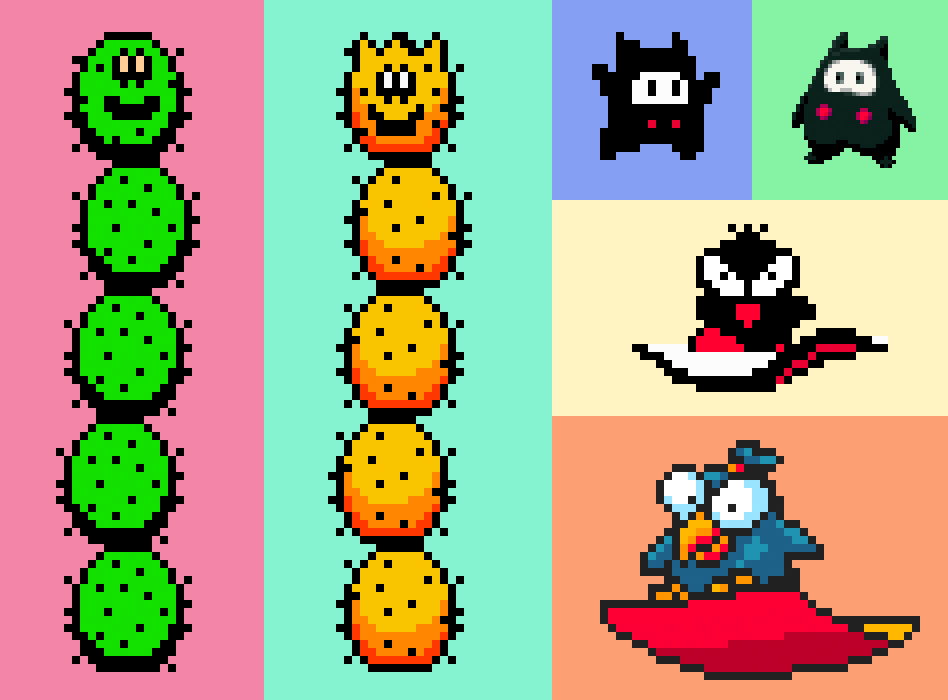
Technically, Ninji and Pidgit also appear in Super Mario World too, but both are easy to miss. The Ninji only appear in Bowser’s Castle levels (notably reusing their original 8-bit sprites) and the Pidgit only appear as one of the aesthetic changes that go into effect once Special Zone is cleared; they replace Bullet Bills for some weird reason. Super Mario Bros. 2 enemies wouldn’t return in a big way until Yoshi’s Island, which made the Shy Guy the first enemy you encounter and the most common enemy throughout the entire game.
Shy Guys have been a mainstay of the Super Mario series ever since. But there’s also a significant portion of Super Mario Bros. 2 enemies that have yet to ever appear in another game, despite prominent placement in adaptations like the Super Mario Bros. Super Show! that made it seem like they’d be part of the recurring monster contingent alongside the originals from Super Mario Bros. Nope! Sorry, losers!

A typically weird episode of the Super Mario Bros. Super Show! featuring Tryclyde, Bowser (as King Koopa), a Koopa Troopa and Mouser dressed mafioso-style and wielding Snifits like guns.
One of the first posts I made on this site was a catalogue of which Super Mario Bros. 2 enemies showed up where (and also where their English and Japanese names come from), and you can read that post here. Though since writing that post, there is the matter of whether the green snakes hiding in jars are meant to be the SMB2 enemy Cobrat. That has its own post, but spoiler: I’m still not sure.
59: Birdo was Yoshi before Yoshi was Yoshi, in several ways.
Another of Super Mario Bros. 2’s contributions is Birdo. Spinoff games often pair her with Yoshi, and in fact she first joined the crew of regularly recurring characters with the Nintendo 64 version of Mario Tennis, as a partner for Yoshi. But despite being similar in many ways, she actually predates Yoshi by more than three years. Regarding four similarities Yoshi and Birdo share, it’s almost as if Birdo serves as a kind of prototype for Yoshi.
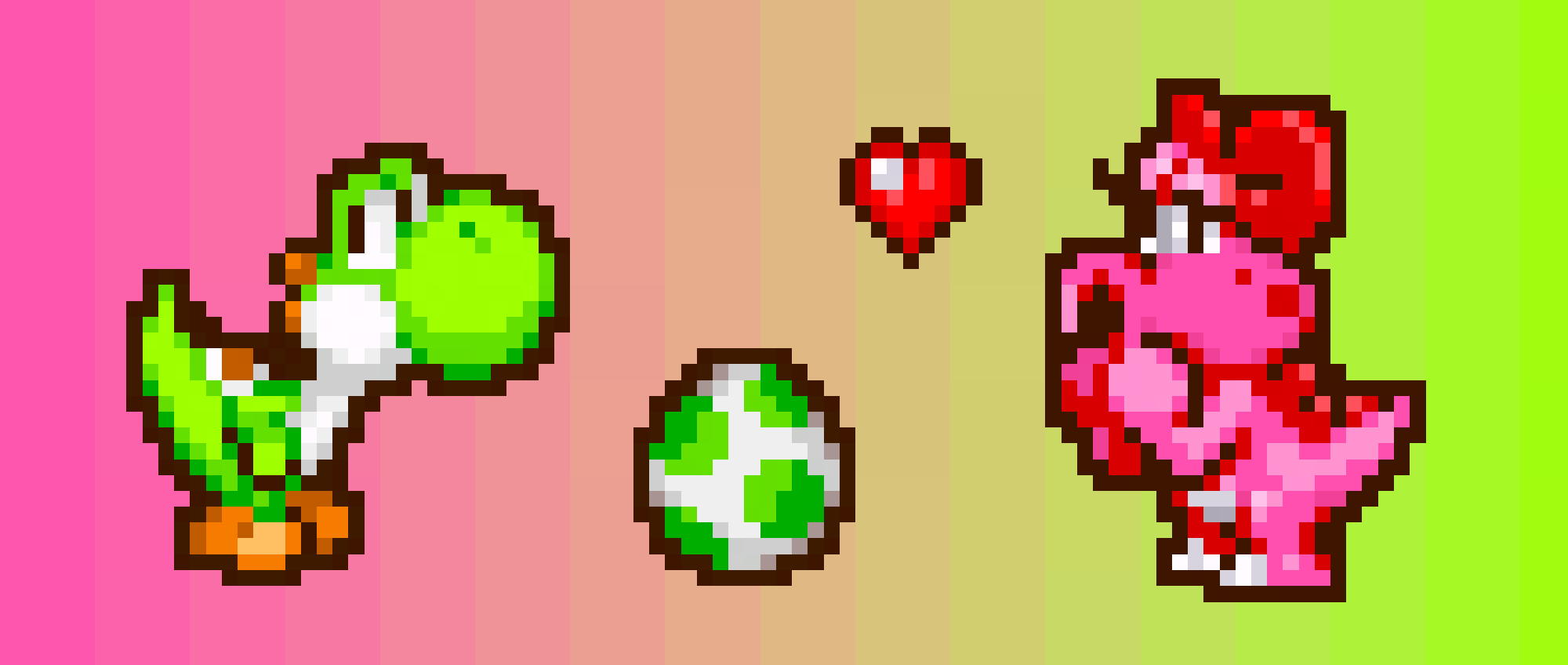
First, they’re both bipedal dinosaur-like reptiles. Lots of dinosaurs walked on their hind legs, of course, but there’s a certain anatomical similarity between Birdo and Yoshi. Second, Birdo’s main method of attack is eggs. While Yoshi would passively lay eggs in Super Mario World, he’d actively fire them off in his first spinoff, Yoshi’s Island, though he’d throw them instead of shooting them out of a bazooka beak the way Birdo does. But the subject of eggs brings us to the third point of comparison: They both transcend gender expectations. Birdo was introduced in the Super Mario Bros. 2 manual as a male character who “thinks he is a girl” and would “rather be called Birdetta.” Nintendo fairly quickly just started calling her female outright, but confusion about her gender has remained. Notably, there’s an often-overlooked way in which Yoshi also subverts expectations about gender, and that’s that he is a male character who lays eggs… which isn’t something that male characters generally do.
Finally, one of Yoshi’s chief roles in the Super Mario games is as a beast of burden, and while Birdo has never given rides in that way, she has this association as well, as a result of an infamous error in the ending to Super Mario Bros. 2. The end credits mistakenly switch her name with that of Ostro, an ostrich enemy that in the game serves as a mount for Shy Guys.
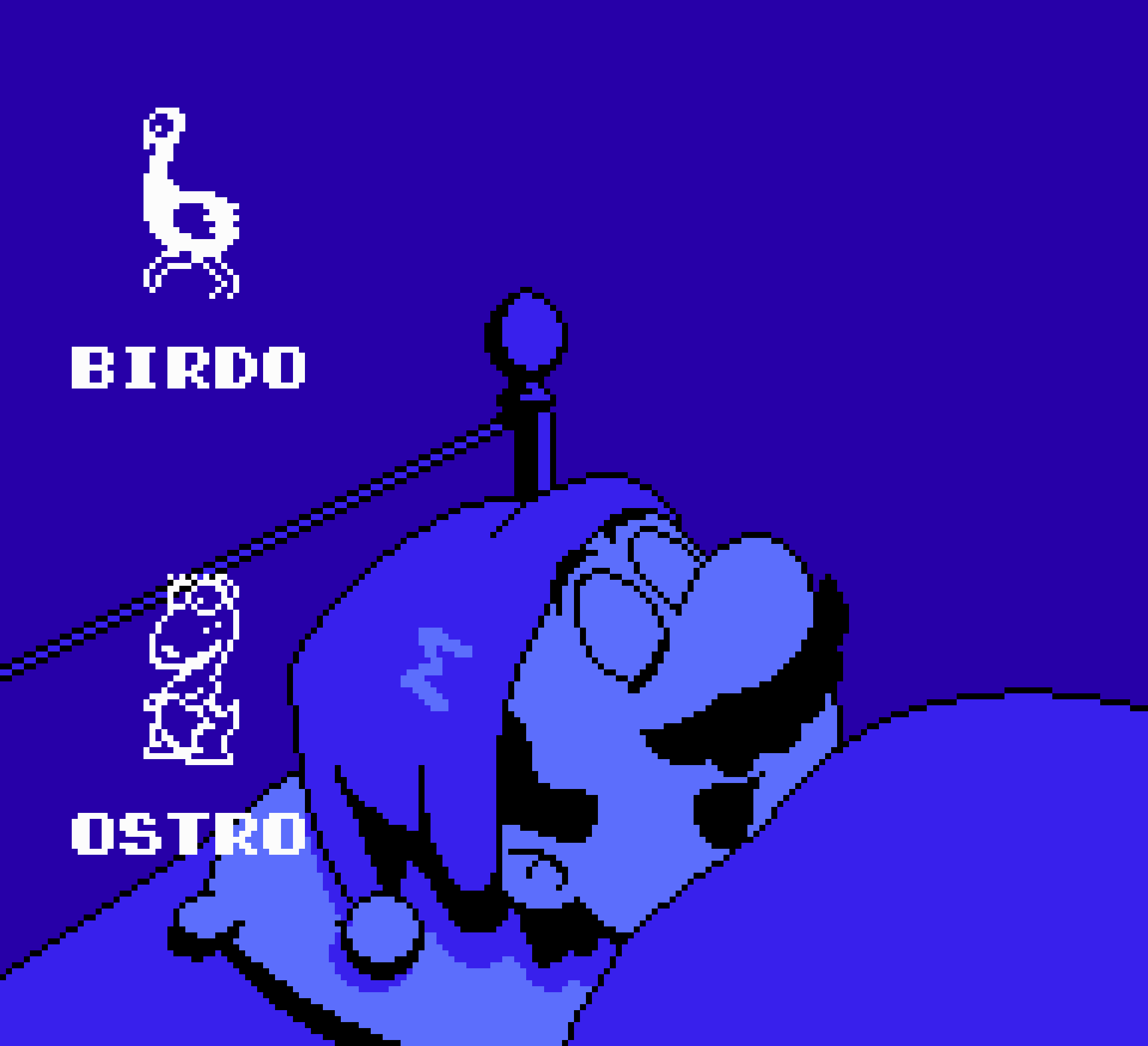
It’s a stretch, I’ll admit, but this connection between her and the fairly Yoshi-like ostrich enemy remained in subsequent versions of the game — even in the manual for Super Mario Advance, released thirteen years after Super Mario Bros. 2.
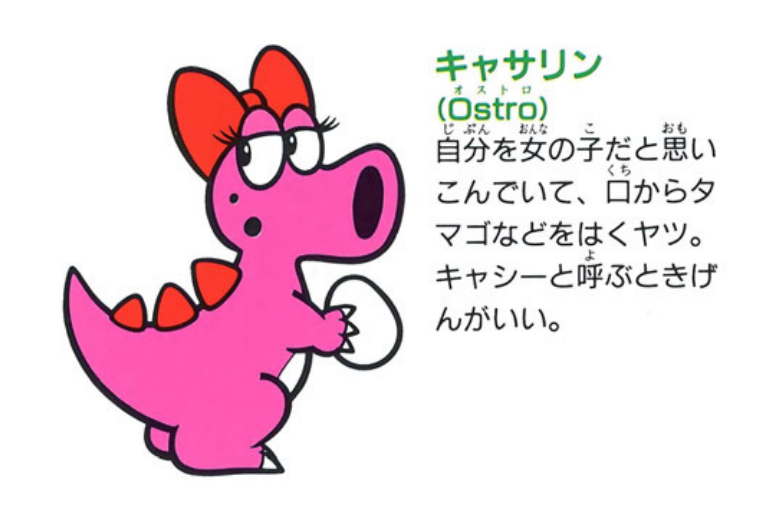
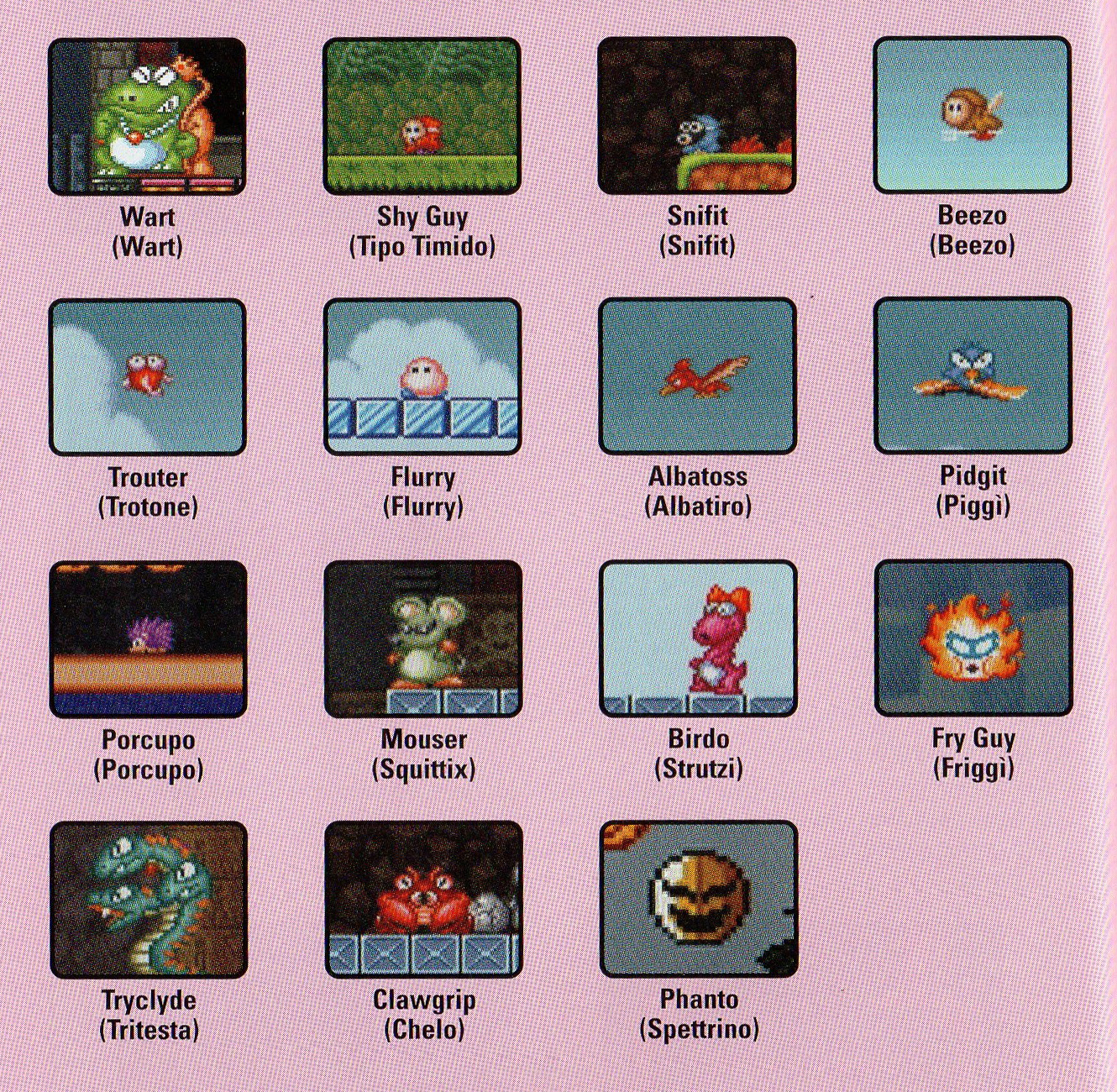
In fact, in some Italian localizations of the Super Mario games, Birdo’s name is still Strutzi — seemingly from struzzi, the Italian plural of “ostrich.”
60: The closest to a confirmation about Birdo’s gender happened in a Super Mario Bros. 2 semi-sequel only released in Japan.
One of Birdo’s claims to fame is for being the first trans character in a video game — and in fact her gender identity is something that Nintendo has winkingly acknowledged in some instances and skipped over entirely in others. If you’re curious, I have documented this in “A Complete History of Birdo’s Gender,” and it’s the most-read post on this site. But closest Nintendo has come to saying, “Yep, she’s trans” happened in a “sequel” to Super Mario Bros. 2: BS Super Mario USA, released in 1996 for the Satellaview, a satellite modem peripheral release in Japan only.
The game is the Super Mario All-Stars version of Super Mario Bros. 2 but with new elements thrown in, like golden Mario statues hidden throughout the levels. It also takes place after the events of Super Mario Bros. 2, and features new characters like the King of Subcon and his oddly Luigi-looking advisor. There was also an audio drama that could accompany the game, with all the characters getting voice actors, including a trio of Birdos — one pink, one green and one red.
To be honest, I’m not completely sure what is going on here, as this version of the game is NOISY, but you can hear Pink Birdo and Green Birdo talking at the 40-second mark. (Via this recording of the original broadcast.)
All three actresses who provided the Birdo voices — Jun Donna, Rika and Akemi — were performers at Shiroi Heya (“White Room”), a nightclub in Tokyo’s Shinjuku area that features trans women as performers. They’re credited — with photos! — in the credits to the game, and in fact, Shiroi Heya is thanked as well.
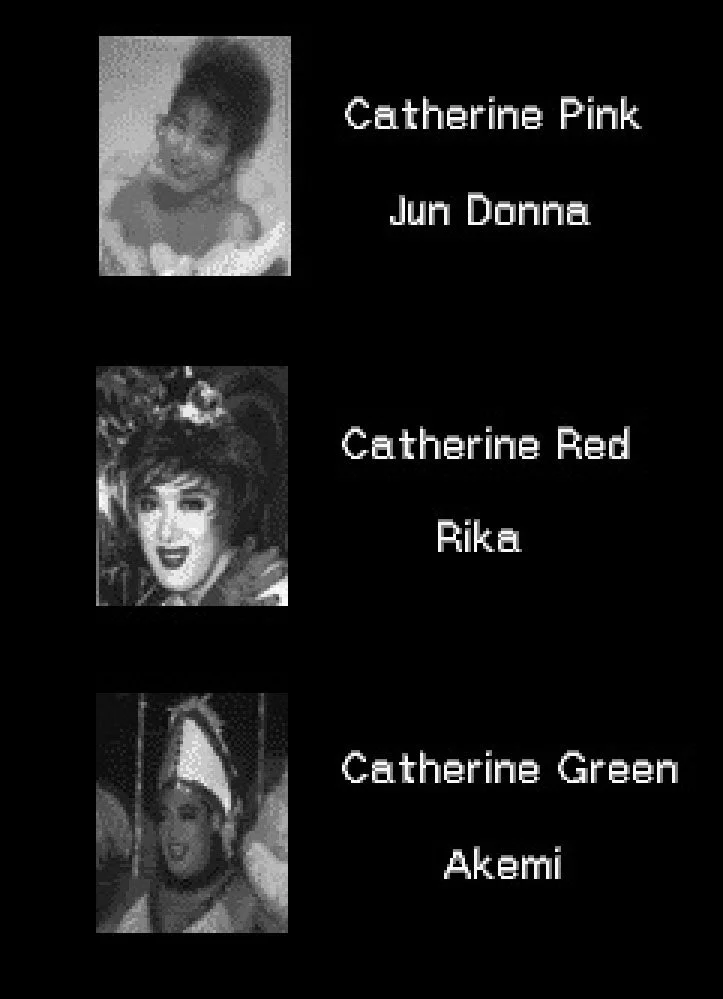
Thus, this is considered by a lot of people to be the most explicit instance of Nintendo acknowledging that Birdo is herself trans.
Navigation:
Part One (1-15): Mario and Luigi origins / Donkey Kong and Mario Bros.
Part Two (16-30): Bowser, Peach and Toad / Super Mario Bros.
Part Three (31-45): The enemies of Super Mario Bros.
Part Four (46-60): Super Mario Bros. miscellany / Super Mario Bros. 2
Part Five: (61-75): Super Mario Bros. 3 and Super Mario World
Part Six (76-90): Yoshi and Donkey Kong (and friends)
Part Seven (91-101): Various beloved supporting characters and also Stanley the Bugman
Part Eight (102–116): A sort of junk drawer including Peach’s dad, Bowser’s wife and the infamous field horsehair plants